
A Brunswick charter boat tackle drawer that changes with the trip
Use one drawer for shared tools and two labeled, interchangeable tackle trays for the inshore and nearshore loads. That gives a Brunswick captain a way to change the working kit without emptying the whole boat. Start with the captain’s actual gear and routines. Two charters leaving the same dock may need very different drawer layouts.
Design my charter boat drawer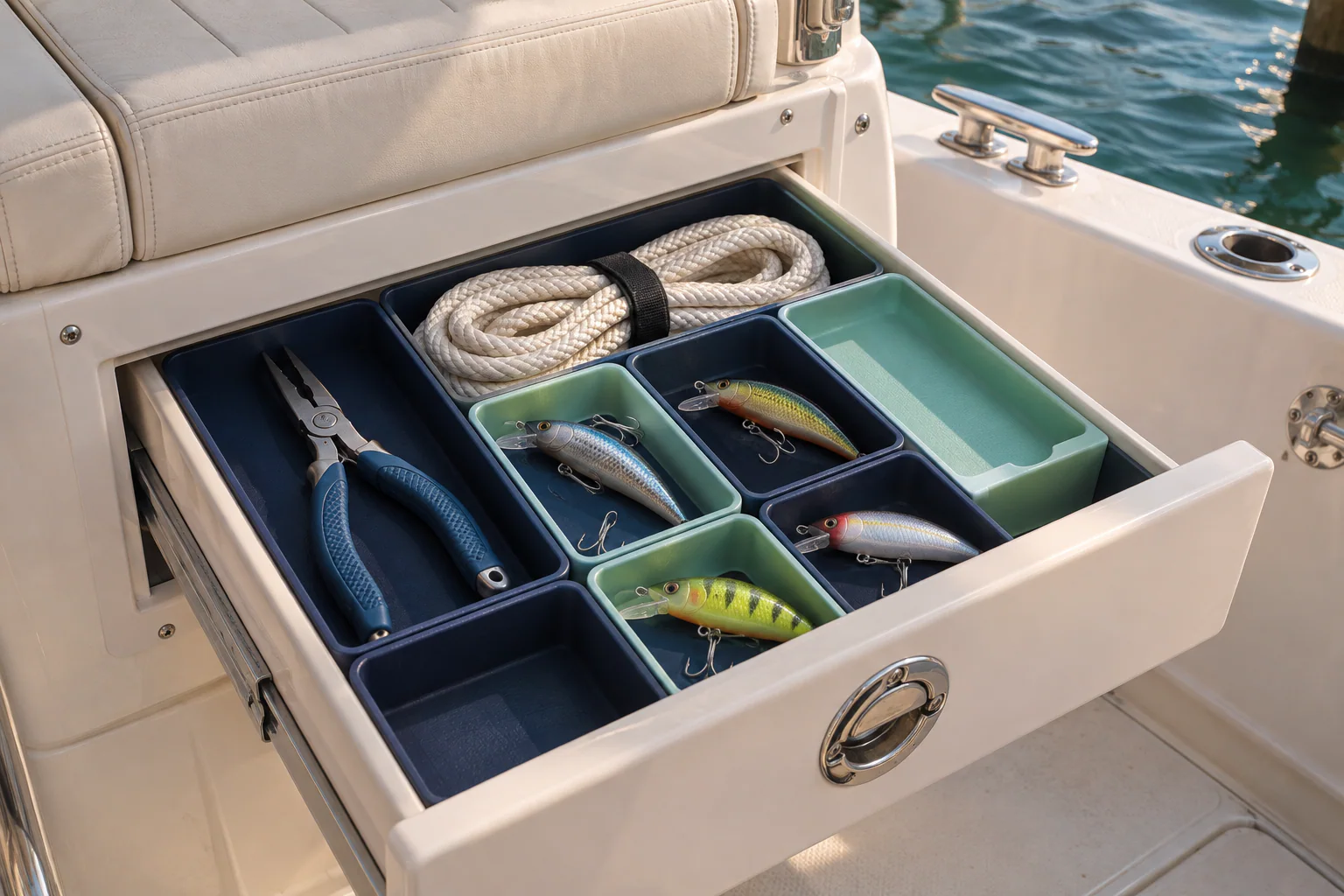
Choose what stays aboard every trip
Coastal Georgia has estuarine tidal creeks and rivers as well as reef habitats beyond the barrier islands. Georgia DNR distinguishes these areas in its coastal reef guides. Your drawer can reflect that change of work without turning a fishing itinerary into a permanent set of compartments.
Spread the gear from two typical trips side by side on dry land. Move each item that appeared on both trips into a third group. This common group might contain pliers, snips or a short ruler, depending on your operation. Lay the tools in their usual stored condition. Their handles and protective covers often determine the size of the compartment more than their metal tips do.
Design the two swap trays
One example layout uses an inshore tray for labeled leader spools and small removable boxes, and a nearshore tray for larger packaged tackle and a wider coiled leader. Treat this as a packing example. Start with your own tackle list, quantities and species-specific practices when deciding what belongs aboard.
Write the trip name where you can read it while the trays are stacked ashore. Put the heaviest items where the drawer and latch are designed to carry them, following the boat and drawer manufacturer’s limits. Keep sharp tackle protected inside suitable containers, then design the insert around the largest closed container. A divider that merely separates two loose hooks cannot contain them on a moving boat.
Sketch a deck changeover before measuring
Imagine one person bringing the replacement tray aboard while another removes yesterday’s kit. Where does the full tray rest for those few seconds? How will the handle clear the drawer lip? Can the installed tray move far enough for a neighboring compartment to open? Run through the changeover with cardboard and the actual closed tackle boxes on a stationary boat.
On paper, measure the usable opening, lowest ceiling under the latch, narrowest floor width and space needed to grasp a loaded insert. Mark drains and service panels as areas to preserve. A cutout for a drain may also need a path leading to it. Discuss the finished material and cleaning routine with the studio.
Order one layout before outfitting the fleet
Photograph the two loads and label the shared items. Send the smaller of your measured drawer footprints if you hope to use the same design on two boats, then note how each drawer differs. Use the ForgeGrid boat page to start a removable layout. Ask for an initial proof to check aboard the intended vessel before commissioning a full fleet or a second set of trip-specific trays.
Questions & answers
What should change between the inshore and nearshore kits?
Change the items that actually vary on your boat, such as terminal tackle boxes, leaders or packaged gear. Keep regularly used shared tools in fixed positions so the crew can locate them after a swap.
What dimensions should I measure for a boat tackle drawer?
Measure the passage into the drawer, the cavity where the insert sits, clearance with the latch closed and the path for lifting it out. Include the outer dimensions of the closed tackle containers.
Can I build around a favorite waterproof tackle box?
Yes. Measure the complete closed box including clasps and hinges. Leave space to lift it and decide whether you need to open the lid while it is still in the drawer.
How should I label two similar-looking tackle trays?
Put a large trip label on a visible edge and identify the contents inside the same way on both trays. Consider a second identifying mark visible when the drawer is only partly open.