
A Christmas gift for the knitter with a dozen projects on the needles
A knitter with twelve projects on the needles probably does not need a thirteenth ball of yarn chosen by someone guessing at fiber and gauge. Ask about the tiny things that disappear between projects: the right stitch marker, the tip size used for the cuff, the little note that says where the shaping began. A fitted notions drawer can hold the memory of a project while the knitter does something else.
Design a ForgeGrid notions drawer with my knitter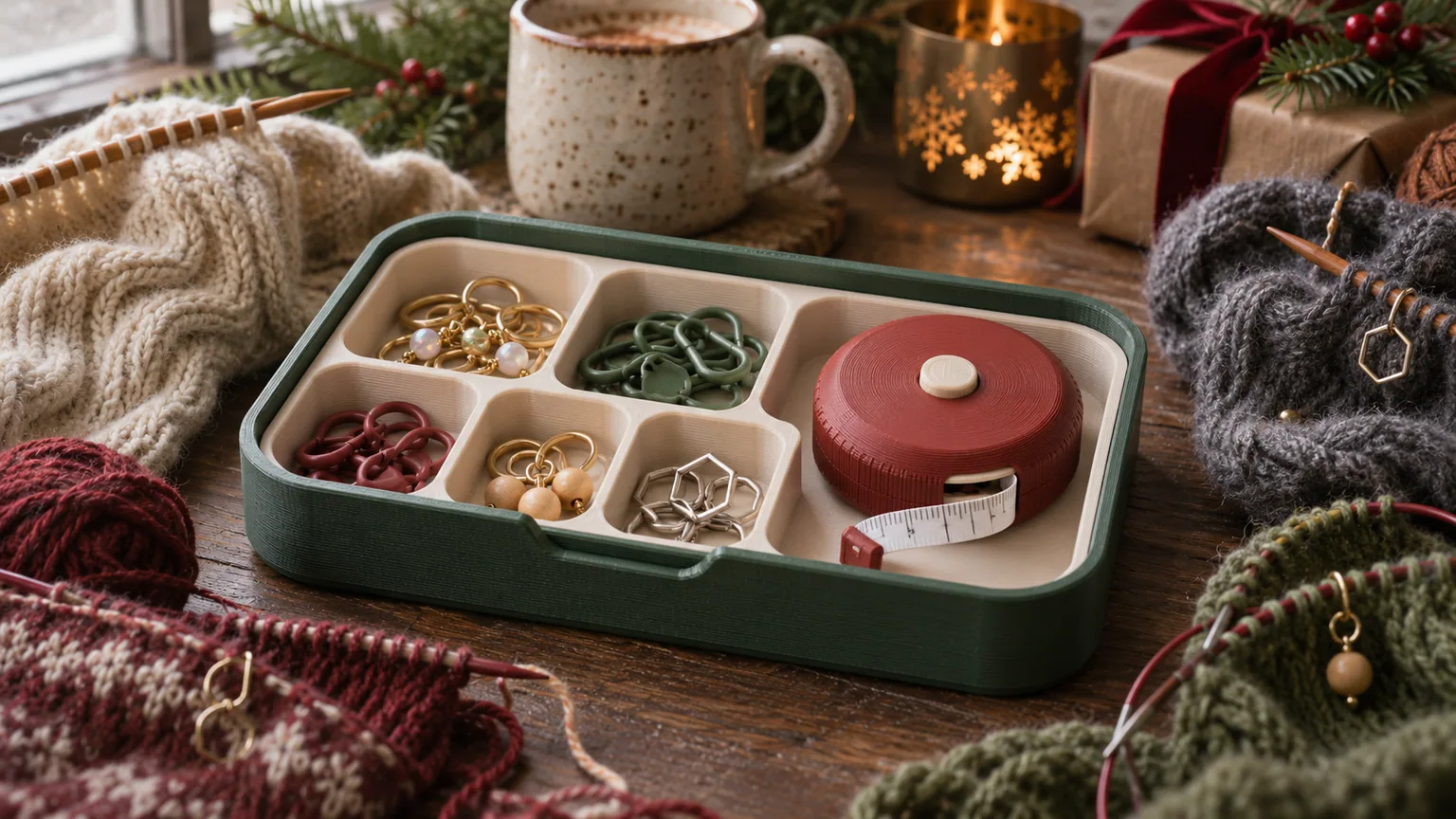
Learn which notions travel with the knitting
A shawl-in-progress often goes into a project bag, and the spare interchangeable tips stay at home. A gauge ruler may move between every bag. Ask the knitter to empty just one bag onto a clear table, with their permission, and tell you what should stay together. Resist the temptation to tidy a work in progress without them. A stray length of contrast yarn or a carefully placed marker can mean something.
Sort for the moment a project restarts
Imagine someone picking up a half-finished cardigan six weeks later. A small card reading “left sleeve, row 14” can help more than a drawer full of notions sorted by color. A removable cell can hold the card, a spare marker and the matching needle-tip caps. The active stitches stay secured on the knitting in their existing system. A separate permanent section can hold the frequently borrowed tape measure and needle gauge.
Measure what looks small but takes up room
Lay the longest spare tips straight and measure them end to end. Coil a cable at the relaxed size it naturally takes, then trace its outline. Tiny markers can stay in their existing lidded tin, so size its proposed cell from the outside of the closed tin. Measure the shallowest height in the drawer. A pretty row of upright needle tips will be frustrating if the tips catch on the frame every time the drawer moves.
Try retrieving one marker with the whole hand motion your knitter uses. Someone who tips the tin into their palm may prefer the tin to lift out intact. Someone searching visually may prefer an open shallow compartment. That choice affects the ideal cell much more than whether the bin matches the yarn.
For someone who knits at meetings, add a place on the paper plan for the little pouch that actually leaves the house. Fill the pouch for a typical outing, then trace it. The outline of the empty pouch can underestimate how much drawer space it needs once the tape and markers are inside.
Give the knitter naming rights
Make a paper version of two layouts. One divides space by project; the other groups notions by type. Let the recipient mark up the one they would reach for after a month away. Enter the real drawer dimensions in ForgeGrid, try the corresponding cells and check the printed full-size template. Request a studio fit review after the knitter approves their own system.
Questions & answers
What is a Christmas gift for a serious knitter whose yarn preferences I do not know?
A notions organizer can complement the tools they already chose. Ask which small item they repeatedly borrow from another bag. Solve that one inconvenience before investing in a fully fitted drawer.
Should stitch markers be stored by size, shape or project?
Match the knitter’s method. Markers used for repeat counting may belong together by color, while distinctive beginning-of-round markers might stay with a specific project. Label a sample layout and let the knitter correct it.
Can interchangeable circular needle cables fit in a custom organizer?
Trace the cables at their natural coil size and measure any connectors or caps. Include a retrieval gap. Avoid designing a pocket that forces a tighter bend merely to fit one more row in the drawer.
Where do I put pointed or very small knitting accessories?
Keep sharp items and tiny notions in their existing secure cases when appropriate, especially in a shared home. Measure those closed cases as objects. Open cells can organize the cases while making them easier to find.
What does ForgeLab need before a fitted notions drawer is ordered?
Enter the clear inside width and depth, check the closed height and identify which actual tools or cases need space. The builder lets you review a layout and request a studio fit check before a custom build is finalized.