
A Christmas gift for a teen who sews their own cosplay
A teen who makes costumes probably has strong opinions about scissors, fabric and the right shade of trim. Give them something they can shape around those opinions. A washable chalk pencil, a spool of silver thread and six tiny closures have different jobs, even if they currently occupy the same biscuit tin. A ForgeGrid sewing layout starts with the costume on their worktable and changes when they start the next one.
Design their cosplay sewing organizer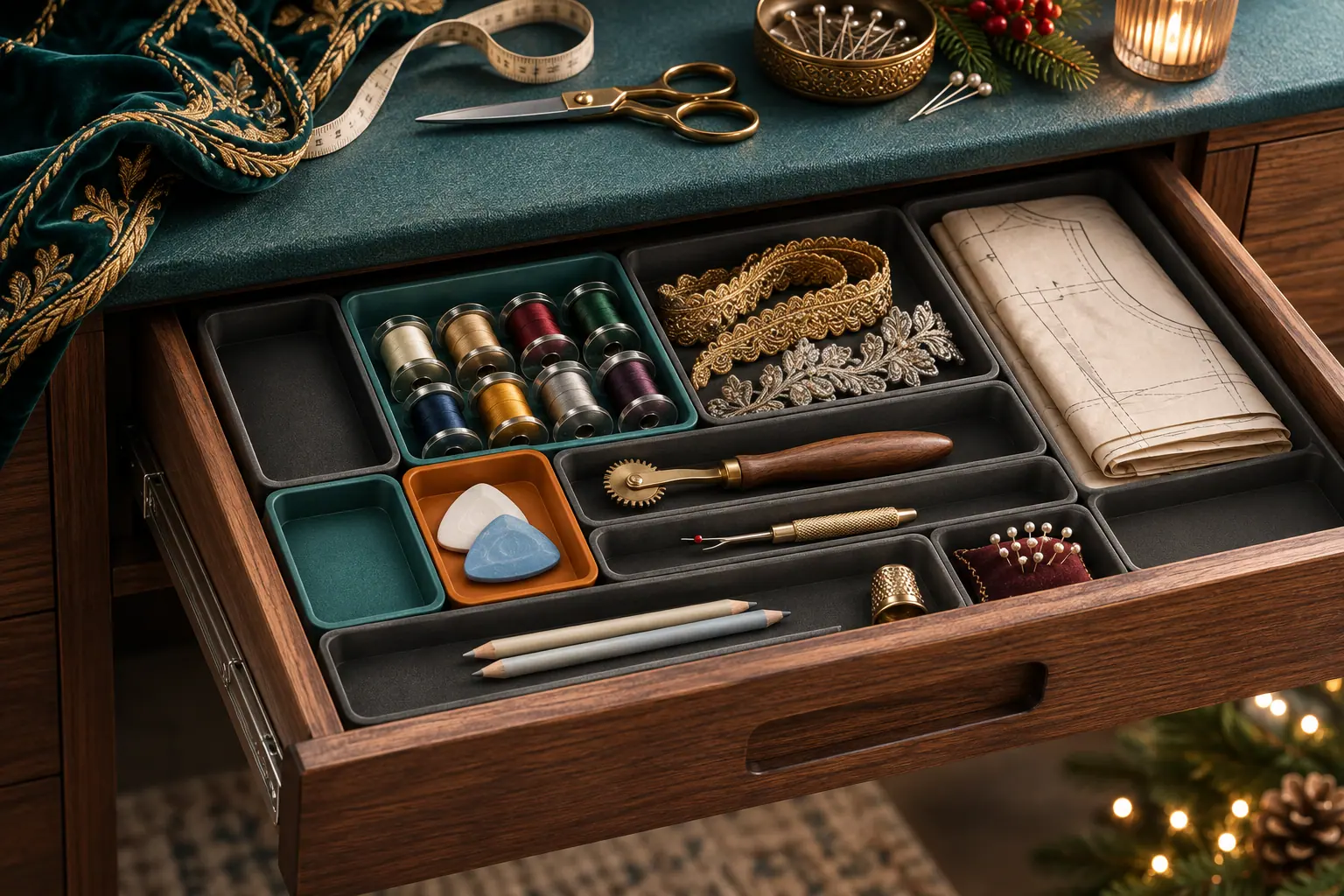
Follow one costume from fitting to final seam
Ask them to show you how they attach one cuff, collar or stripe of trim. Watch which objects come out together. A maker may carry clips and a measuring tape to a mirror for fitting, then return to the machine for a bobbin and seam gauge. Those are two working groups. Sketch a cell for the fitting tools that can travel to the mirror and a second cell that stays near the machine.
A small surprise can survive that conversation. Ask about the costume because you are interested, then make a note of their own names for the tools. Put those names on the gift card. A plan marked “cape fittings” means more to its owner than someone else's classification system.
Measure awkward supplies before buying storage
Measure a bobbin across its widest flange and note how it sits when picked up. Set several clips in their normal heap and trace the outline. If your teen keeps threaded bobbins with their matching spools, measure the pair together. A deep narrow pocket might hold a single spool neatly and still hide the bobbin that belongs to it.
Measure the drawer opening and the usable height under its top edge. Allow space to lift objects out without tipping the tray. If the machine table has no drawer, outline a small surface zone beside the machine, away from the fabric path. A full drawer layout would answer the wrong question there.
Keep one space for a costume still in progress
Sketch three areas on scrap card. Put hardware for the current costume in one, repeatedly used tools in another, and leave one blank. Drop a few sample items onto the outlines. A row of fixed little pockets looks tidy until a new character calls for a wide buckle. The empty rectangle gives the design somewhere to grow.
Keep loose needles in the owner's existing closed needle case and blades in their protective covers. An open ForgeCell works well for clips and wrapped notions. Give the case its own parking spot if your teen wants everything together.
Let the maker approve the final layout
Open ForgeGrid, enter the measured space and try removable cells. Save the arrangement you want to show your teen. Wrap a swatch or ribbon from a favorite costume with the sketch and invite them to move one cell before you request a custom fit review. That final change is part of the fun and catches preferences a parent could easily miss.
Questions & answers
What belongs in a cosplay sewing organizer first?
Start with the things that stall an actual seam when they go missing. Clips, a seam gauge and the correct bobbin are stronger first candidates than a full collection of trim. Add seldom-used embellishments after you know how much working space remains.
Can two kinds of bobbin share one compartment?
Keep bobbins grouped by the machine or labeled case your teen already uses. Two nearly identical flanges can be difficult to tell apart from above. Measure both sets separately and leave a finger space between their groups.
Should I surprise a teen costumer with an exact scissor slot?
Only if you can measure the scissors with their sheath in place and confirm which hand retrieves them. A generous removable cell is more forgiving when tools change. Leaving scissors in their current case can also preserve a habit that already works.
How can the organizer work for convention prep?
Design one lift-out group for packing clips, spare closures and a measuring tape. Transfer that group into a closed travel pouch for the trip. The open desktop cells organize objects at home and the pouch contains them when carried.
Does creating a ForgeGrid design order the organizer?
The planner lets you try layouts and request studio review. Share the drawer measurements, the largest unusual notion and any constraints before asking for production details. Agree on fit and price through the studio before committing to a custom build.