
How to build an espresso drawer around your tamper, baskets and scale
Build the drawer around the sequence you follow before the first espresso. Put the scale where you can pick it up by its edges, the tamper where the handle clears your knuckles and baskets where you can distinguish the one you want at a glance. A fitted organizer earns its place when you can retrieve those three things without lifting the accessories that live behind them.
Build my ForgeGrid espresso drawer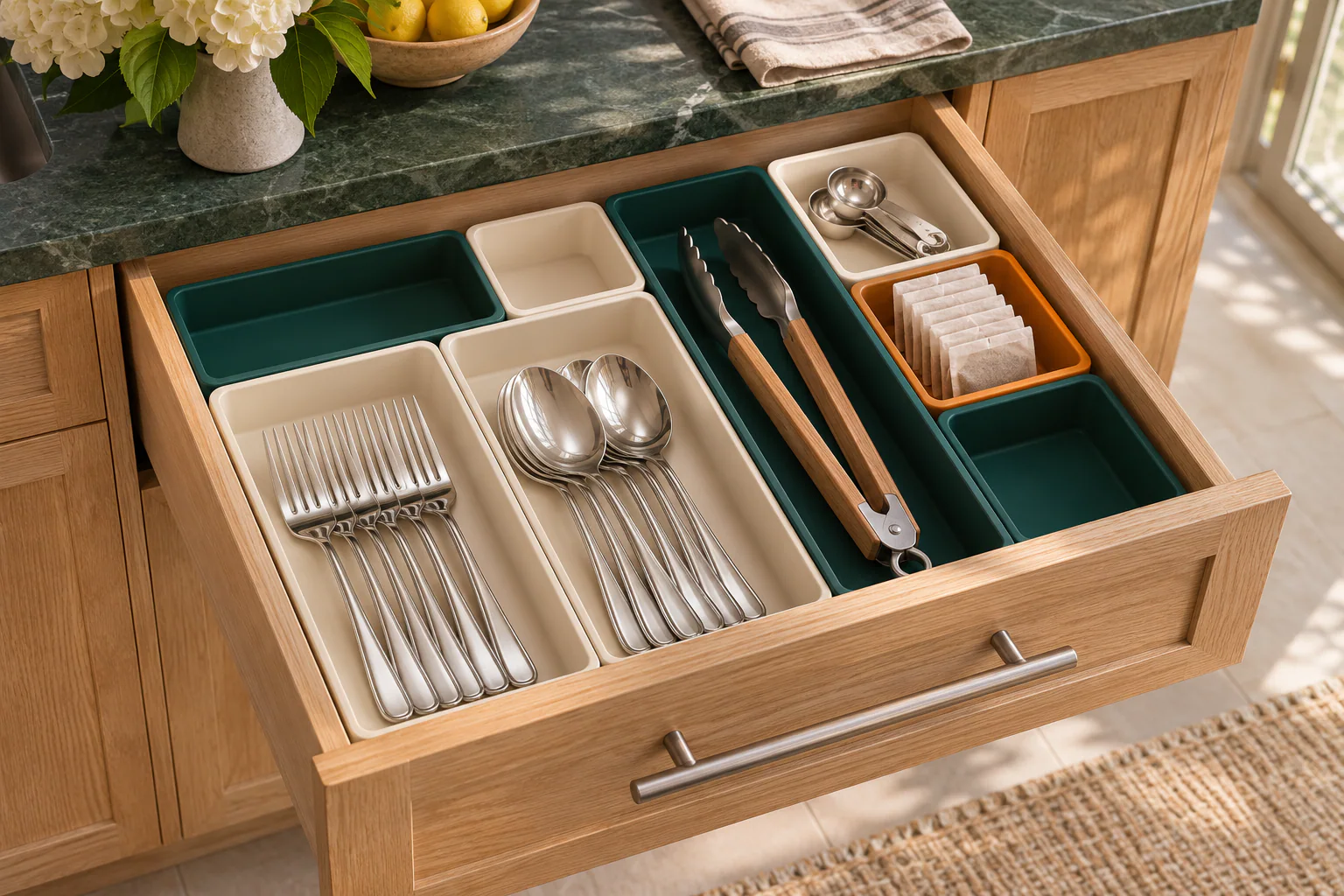
| Kit | First pieces to place | What to measure |
|---|---|---|
| 54 mm home setup | Scale at the front, baskets behind it, tamper along one side | Outer basket lip, tamper handle and space to lift the scale |
| 58 mm kit with a dosing funnel | Separate lift-out basket tray, with a dedicated space for the funnel | Widest rims and funnel opening, plus clearance around neighboring items |
Measure the kit you own, including the bits that stick out
Write down the machine and accessory names, then measure the outside dimensions of each actual item. Breville, for example, describes the Barista Express as a 54 mm portafilter setup. That is a helpful identity for the kit. Its handle, the lugs sticking out from a portafilter and the outer lip of a basket may all extend beyond its nominal coffee size. An organizer needs the storage footprint.
Measure the tamper upright and on its side. Include a mat if it will live in the drawer. Measure the scale with a protective cover if you use one, and check whether the charging plug needs access in storage. Write “loose cable” or “cable attached” beside the measurements so the layout reflects what happens at home.
Compare two plausible layouts on paper
For a compact 54 mm home setup, try the scale flat at the front, two clean baskets side by side behind it and the tamper on its side along one edge. Cutting out the actual outlines is faster than trying to draw everything to scale by eye. Put the cutouts on a sheet the size of the usable drawer. Then place the real pieces over them and see whether your hand can reach the handle.
For a 58 mm kit with a dosing funnel and additional baskets, try a separate lift-out basket tray. Set a funnel over a paper outline of the scale to see what space it would block. Do not assume the wider kit only needs four extra millimeters across the whole drawer. Several adjacent wells, plus different rims and accessories, can change the best arrangement entirely.
Check height and access before you fit the base
Measure the clear height at the lowest rail or lip the drawer passes under. A scale or tamper may fit at the front yet snag as it passes beneath the frame. Check an empty cardboard mock-up first and close the drawer gently. Place the heaviest loose item down low rather than balancing it above delicate accessories. Leave wet tools out to dry before putting them away.
Pull the drawer open as far as it normally travels. Can you read the marks on a basket at the back? Would moving a spare basket into a labeled removable bin free a better front spot for the one you actually use every morning?
Build your own coffee drawer in ForgeGrid
Start with the kitchen layout and enter the internal measurements. Reserve a flat area for the scale, choose an open lane for the handle, then use small removable cells for baskets, brushes or clips. For an exact circular recess, supply the measured outside rim and a top-down picture with a ruler. The studio can review those details before you commit to a fitted print.
Questions & answers
Can a 54 mm basket use a 54 mm recess?
The number on the espresso equipment is a starting descriptor. Measure the widest point of the basket you plan to store, including its lip, then allow room to lift it. A pocket that copies the printed number exactly may bind.
Should a tamper stand upright or lie down?
Test the handle height against the clear opening. Upright storage is convenient in a tall drawer. A side cradle can work in a shallow drawer if it supports the base and still gives your fingers space around the handle.
Where should the scale go if several people make coffee?
Give it a front or side position with space to grip both edges. Keep metal tools out of its storage pocket. A separate open bin for the charging lead can make the drawer easier for everyone to reset.
What if I upgrade my espresso machine later?
Keep model-specific baskets and the tamper in removable cells. Choosing a general flat bay for the scale and an open lane for tools gives you more options if your next machine uses a different kit.