
A glove box organizer that keeps registration papers flat and within reach
Build the organizer around the document sleeve you reach for, including its flap. Loose pens, loose change and charging cables can share the compartment without sitting on the paperwork. Put the sleeve in a separate document space and leave an exposed edge that a hand can reach when the vehicle is parked and the glove box door is open.
Plan my glove-box document tray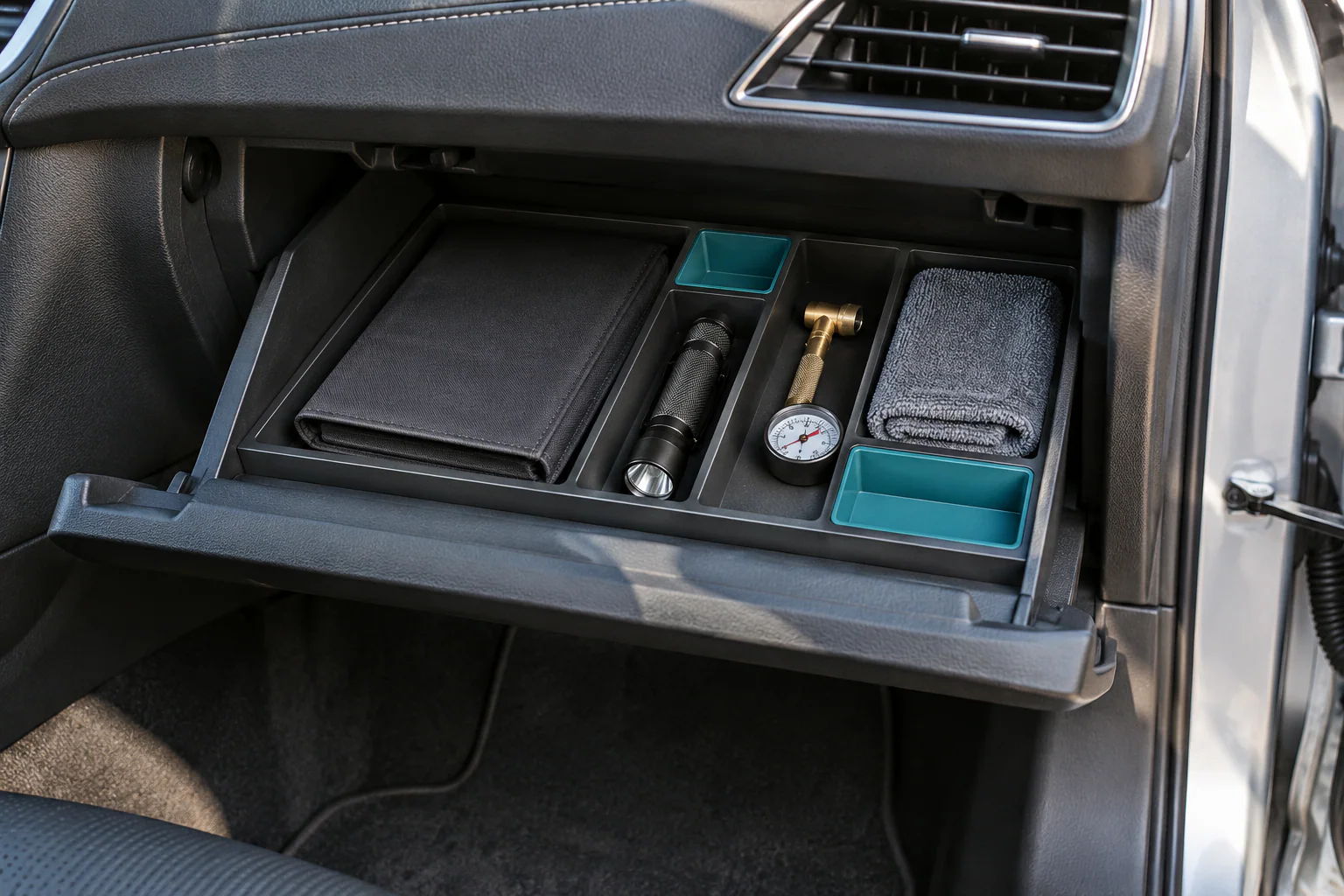
Find out how the sleeve needs to leave the box
Empty the glove box and place just the closed document sleeve inside. Try pulling it straight out, then toward the passenger seat. In a compartment that swings down with its door, the shortest reachable edge can change as the box opens. Mark the easiest grip point on a paper copy. Keep identification numbers and addresses out of any fit photographs.
Many document sleeves are a little larger than the paper they hold, especially around a stitched border, ring or zipper. Measure the sleeve with its usual contents. If a copy of the owner’s manual stays underneath, measure the combined stack. Leave enough room to slide the sleeve out without bringing the book with it.
Separate a paper lane from the small-item bin
Try a flat open-ended channel along the base where the glove box provides a supported surface. Another option is a document pocket positioned along a side wall in a tall compartment. Test both with folded paper before choosing. The loose-item bin belongs on a separate support so the weight of its contents does not crease the sleeve.
For example, a 205 × 115 mm sleeve can appear to fit a 215 mm deep bin. If the back wall curves inward over its last 20 mm at the sleeve’s height, usable depth along one edge might be only 195 mm. A cardboard duplicate will reveal the bent corner the centerline measurement misses.
Test the door with the actual load
With the vehicle parked, fit the mockup with the sleeve and ordinary lightweight contents. Close the door gently and check that it latches like it did empty. Open it several times and watch for the tray or paperwork tipping, riding up the back wall or catching on the door. Maintain clearance around hinges, stops, the latch and any service-access panels.
A grab tab is helpful only if it stays within the compartment during closure. Place it where a passenger can feel it when the door is open without leaving it trapped in the latch. A separate shallow holder for the pen is often enough to prevent the document sleeve becoming the pen’s slide ramp.
Take a privacy-friendly fit photo
Use a blank sheet cut to the sleeve’s dimensions, marked FRONT and OPEN EDGE. Put a ruler alongside it and photograph the glove box open from the passenger side. Start the ForgeGrid glove-box layout, enter the usable measurements and identify where the sleeve and small-item bin belong. Keep your actual documents with you while sharing the layout.
Questions & answers
Do I need a tray for a full sheet of paper?
Size the tray for the sleeve and fold arrangement you already use. A folded document inside a larger wallet takes the size and thickness of the loaded wallet when stored.
Should the sleeve go above or below the owner’s manual?
Try it above if the manual has a stable resting surface. A separate open-ended lane allows the sleeve to slide free without lifting a heavy book every time you need the papers.
What if my glove box opens at a steep angle?
Test a blank sleeve at the fully open angle while parked. A shallow front lip can help if it still leaves a grip edge. Show that angle in your fit request.
Does ForgeLab need a photo of my registration?
No. A blank paper template with the outside dimensions, a photo of the empty glove box and a description of the sleeve give the studio the relevant fit information.