
One drawer pull is missing. Here’s how to match the other three.
When one handle is missing from a dresser, you already own the most useful catalog: the other drawers. One surviving pull tells you where the screws go, how much room fingers need and what the finish looks like after years of handling. Start there before shopping by terms like “vintage brass” or “campaign style.” Those describe hundreds of handles that can look right and still leave two holes showing.
Request a match for my drawer pull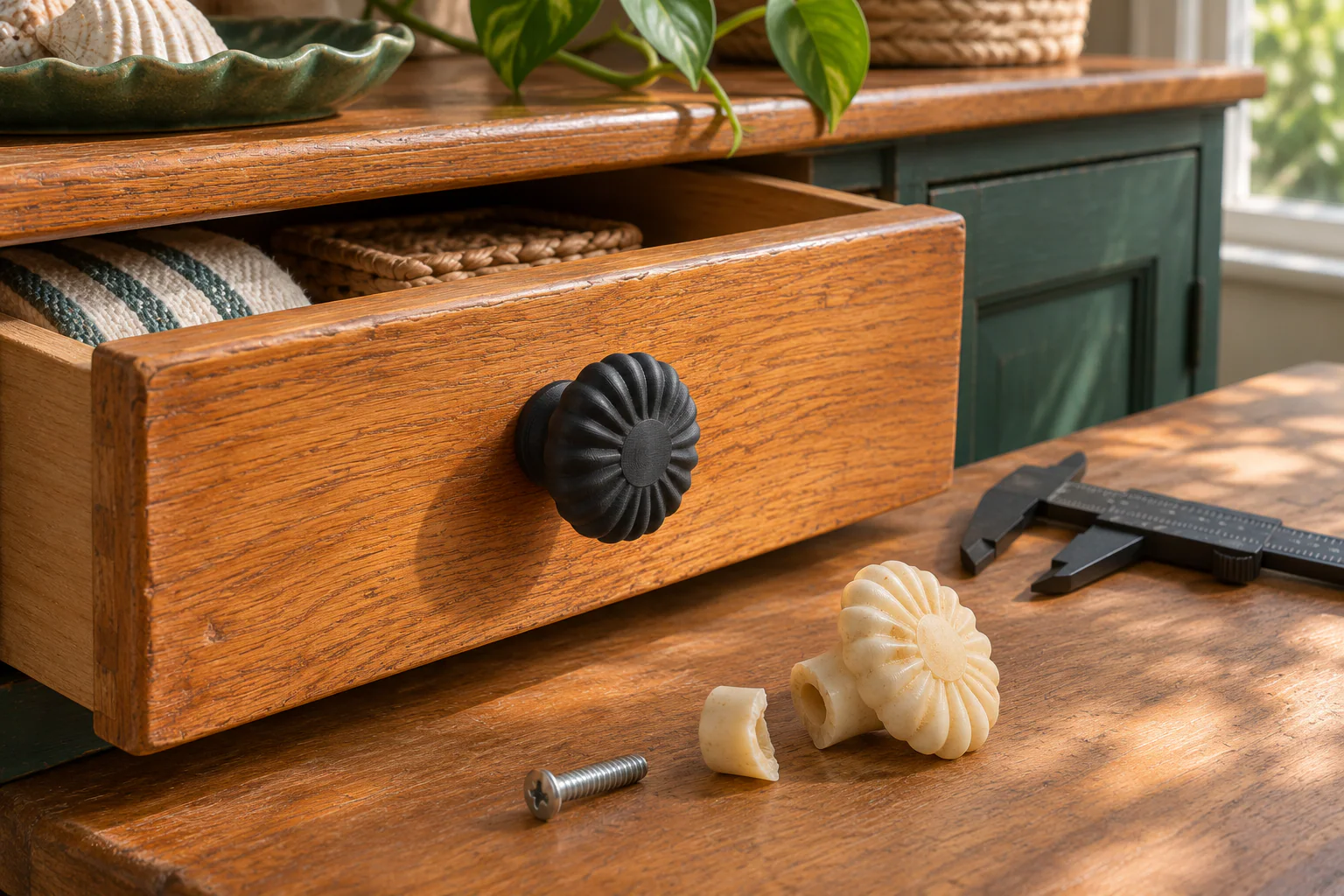
Measure the distance between holes, then the handle itself
For a two-screw pull, the listing dimension usually worth finding is center-to-center spacing. Measure from the same edge of the first hole to the same edge of the second, provided the holes are the same size. This gives the same distance as measuring center to center and is easier to read with a ruler. Now measure the full length of the pull separately. Keep both numbers on the drawing.
For example, an imaginary handle might be 118 mm long and attach to holes 96 mm apart. Searching for a “118 mm center-to-center handle” sends you after a different part. If the existing holes look elongated or uneven, repeat the measurement on a second drawer and record which one is damaged.
Find out what your hand and the drawer front require
Measure from the face of the drawer to the outermost point of the pull. Then check the usable space underneath the grip and the width of each mounting foot. A wide mounting foot might hide a lighter patch in the wood left by the old handle. A narrower one can fit the screws perfectly and still expose that patch.
Stand beside an open neighboring door or drawer and look across the handles. A few extra millimeters of projection matter in a tight corner. Record whether the handle swings down, sits on separate posts or is a single fixed piece. Photograph the back of an intact handle only if it comes off without disturbing fragile wood.
Capture the finish you have today
Place two surviving pulls in the same photograph if you can. Take a second picture in daylight without flash and include an ordinary sheet of white paper nearby. A bright face and dark recessed details can make one piece look like two different finishes depending on the angle.
Decide what you want to preserve. For a family heirloom, a genuine donor with similar wear may be worth waiting for. For an everyday dresser, reproducing the silhouette in a deliberately different finish on both top drawers can look more intentional than a nearly matching handle in the middle of a row.
Turn the surviving pull into a useful ReForge brief
Send the whole dresser, one handle in profile and the hole pattern with dimensions. Say whether the brief is a visual sample or intended for daily pulling, and describe the drawer's size and how easily it moves. Hardware, fasteners, material and repeated-use requirements belong in that review. Ask about one proof before committing to a matching pair or a whole set.
Questions & answers
Is overall pull length the same as screw spacing?
Usually they are different measurements. Two pulls with the same center spacing can have dramatically different overhangs. Compare both measurements, especially if the finish around the old feet is visibly worn.
What should I measure if my drawer only has one screw?
Record the diameter of the mounting footprint, the grip diameter and projection. Photograph the screw and the opening from the back so the studio can evaluate the fastening method.
Can I match patina from one phone photograph?
A photograph conveys color direction and wear. Reflections, lighting and screen settings influence the appearance. A donor piece or a physical finish sample is stronger evidence when a close visual match matters.
Can an old pull be copied without drilling the drawer?
Existing hole spacing gives a designer a fixed starting point. Confirm that the wood, screws and receiving hardware are sound, then specify that the proof must use the present holes.