
Puffco Peak vs. Peak Pro: can the same tabletop organizer hold both?
A generous flat landing area can sometimes serve two Peak models stored one at a time. A contoured pocket is a different purchase: its support edge and shape must suit each device. Tell the designer whether “fits both” means alternating between two devices or keeping both on the table together. Those requests lead to different designs and different footprints.
Design a DabLab for my Puffco Peak model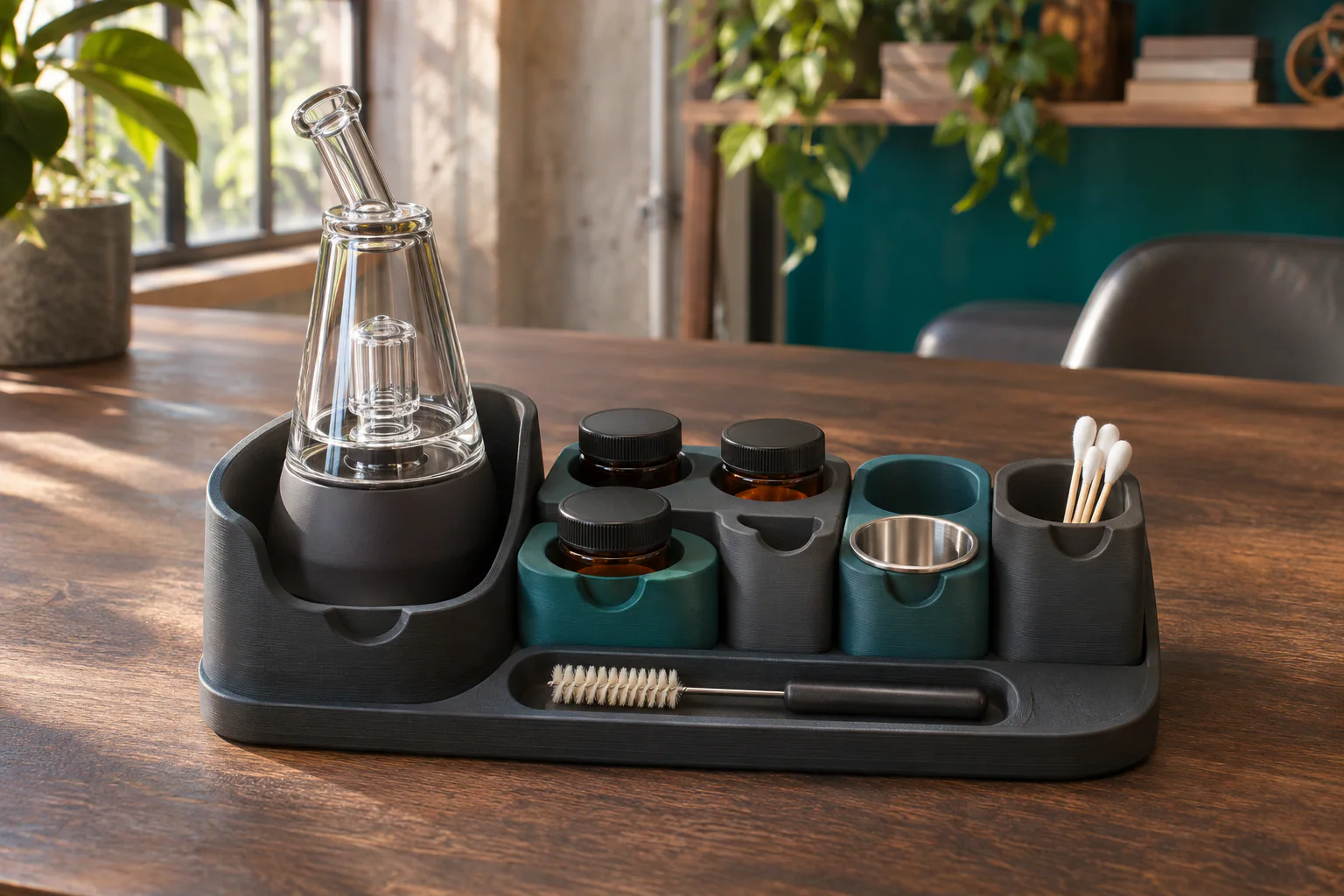
Use the model names on your equipment
Puffco lists the current Peak and Peak Pro 3DXL separately. ForgeStation likewise offers separate entries for the New Peak and Peak Pro 3DXL. An earlier Peak Pro with a different setup deserves its own description. Look at the original order or packaging if the name is uncertain. Add details about a protective cover, cap or glass that changes the shape at rest.
Line up the cool devices with their front faces pointing in the same direction. Photograph each separately, then draw two outlines on translucent paper. Mark the part of the body that actually touches the table. Turning one drawing until the upper silhouettes match may still leave a lower edge unsupported.
Compare shared space against a fitted pocket
For a shared landing area, use the larger width and larger depth of the two setups. If one illustrative outline is 90 by 95 mm and the other is 94 by 89 mm, the smallest rectangle enclosing both in those orientations begins at 94 by 95 mm. That calculation only describes the outline. You still need access around the sides and a level contact surface for each base. A contoured recess also needs inward curves, corners and ledge depth checked on both profiles.
Decide which inconvenience you want to remove
A single open bay is useful when gear rotates and you prefer to keep the jars and capped tools in the same positions. A snug individual profile makes more sense when one device lives there permanently. Side-by-side storage needs two separate resting areas plus the gap between the upper glass profiles. Try two pieces of paper with cups standing in for your jars. Move the rear device forward as you would to pick it up. The width on the map can work while the access from your seat still feels awkward.
Configure the device you use most
Choose that device in DabLab, enter its outside measurements and add the accessories you actually keep on this table. The standard builder describes one device bay. For two devices, ask the studio for a two-bay design and send the second outline separately. For alternating use, state explicitly that both bases must sit flat in the same location. This small note gives the studio something concrete to review beyond the word “universal.”
Questions & answers
What is the best type of organizer for someone who may upgrade their Peak?
A layout that separates everyday jars and tools from a simple device landing area gives you more options later. If you choose a closely shaped cradle, ask how it could be revised when your next device is known.
Will a Peak Pro stand fit a New Peak if the base looks smaller?
A smaller outline can still rock on the wrong supporting ledge or end up too deep to lift comfortably. Compare both profiles at the height where the stand meets the device. Leave enough of the body exposed for a normal grip.
Do I have to measure with the glass installed?
Measure in the exact condition you plan to store it. If the glass stays attached, include its widest reach and total height. If it comes off for storage, request a separate supported spot and supply the loose glass dimensions.
Should my measurements include space for my hand?
Give the studio the actual outside device measurements first. Describe finger access separately, including the side you grasp. An inflated device measurement can make the well unexpectedly loose while still leaving the wrong side blocked.