
Match the material to the actual exposure.
Plan a trim mockup, bracket envelope or interior fit study against the actual space in your vehicle.
Example project
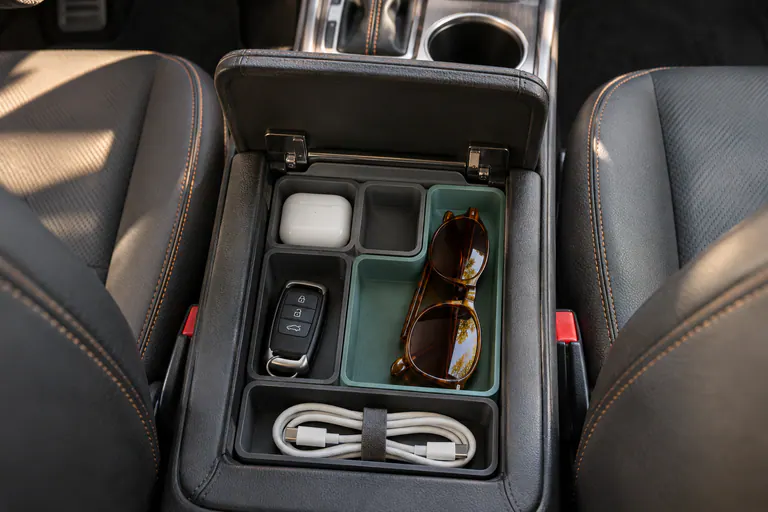
A lift-out tray for an awkward center console
Reserve the deepest area for sunglasses and a reachable front pocket for keys. Trace where the lid, hinge and charging cable travel, including the opening through which the tray must pass.
Check it in the real space
Cut a card outline and lift it in and out with the cable plugged in. Mark where a corner or cord catches before capturing the final dimensions.
Use the center console guide for a fitted organizer. Bring a separate trim or control mockup to the studio with its mounting dimensions.
Explore the console layoutWhere are you starting?
Start with this decision
Take a photo of the mounting location and identify what sits beside it. Decide whether your first sample is for checking appearance, access or mounting clearances.
Try the project toolWhat you can make
- Instrument-panel and trim fit mockups
- Under-hood packaging models for stationary layout checks
- Service-bench fixtures and prototype control knobs
Read the studio’s approach
A display knob, a packaging mockup and a temporary bench fixture lead very different lives. Describe the use, mounting geometry and heat exposure before choosing a custom automotive print. Compare published data for specific grades, then use ForgeCloud™ to prepare a quote for your model or ReForge™ to describe a discontinued trim part.
Heat and exposure comparison
Compare the heat-deflection temperature of named supplier specimens at a selected test stress. Open each grade sheet to inspect the source conditions.
| Grade | Method / load | Reported HDT |
|---|---|---|
| Stratasys FDM Nylon 12CF ↗PA12-CF reference for ForgeCarbon™ inquiries | ASTM D648 B264 psi | 129.8 °C XY · 153.7 °C XZ/ZX |
| Stratasys ABS-M30 ↗ABS | ASTM D648 B264 psi | 100.0 °C XY |
| Stratasys ASA ↗ASA | ASTM D648 B264 psi | 98.2 °C XY · 97.6 °C XZ/ZX |
| Prusament PETG ↗PETG | ISO 751.80 MPa | 68 °C · orientation unspecified |
HDT measures specimen deflection in a short test under bending load. Continuous service temperature, chemical resistance and an installed component’s performance need separate evidence. Stratasys and Prusament report different standards. The ForgeCarbon™ lot and build orientation need their own records.
Record sustained and peak temperatures at the actual location, exposure duration and how the part is loaded.
Organizing the inside of your vehicle?
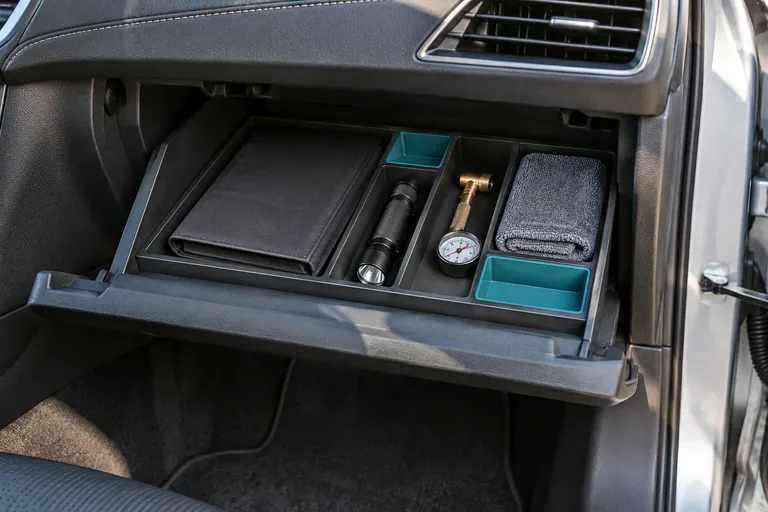
A hinged glove box and a deep console call for very different shapes. Choose the compartment you have and see which opening, hinge and clearance details to bring to the studio.
Choosing a high-temperature filament for an under-hood prototype
Questions before you start
Which custom car parts are good starting projects?
Cabin trim mockups, appearance knobs, cover studies and workshop holding aids have clear fit or appearance questions. Send a photo of the mating feature, two or more known dimensions and the expected use. Keep dimensional prototypes distinct from parts released for operation.
How should I compare ForgeCarbon™ PA12-CF with ABS, ASA or PETG?
Request a supplier grade, process, specimen orientation and heat-deflection test condition for each candidate. The linked manufacturer data illustrates how much those fields matter. Confirm the actual ForgeCarbon™ build data for your order before using a different brand’s material properties in a decision.
What temperature information is useful for an under-hood prototype?
Describe the component location, nearby heat sources, air movement, peak duration and any sustained clamping force. Provide existing measurements from the responsible technician if available. A stationary clearance model and a part expected to survive repeated heat cycles require different scopes.
Can the studio recreate a broken trim knob from photographs?
For an ordinary cosmetic control, include the front, back and side, a ruler in the same plane and measurements of the shaft or socket. Mention the indexing flat and operating direction. Use ReForge™ if the original CAD is unavailable.
Can I order an installed safety-critical vehicle component through an instant quote?
The browser estimate covers geometry, material and a proposed print run. Steering, braking, restraint, fuel-system and other safety-critical applications require a separately qualified process and approval by the responsible vehicle engineer. A packaging mockup can be scoped separately with an explicit bench-only use.
What should I check on a first trim-fit prototype?
Verify the mating shaft, clips and installation path without forcing the prototype. Photograph the gap and contact marks, record the model revision and note which faces control the visible alignment. Use that record to revise the local geometry before paying for the final cosmetic finish.