
Make room for the things you use every day.
Make a desk drawer where you can find the right cable, pick up a tiny card and put your earbuds back with one hand.
Example project
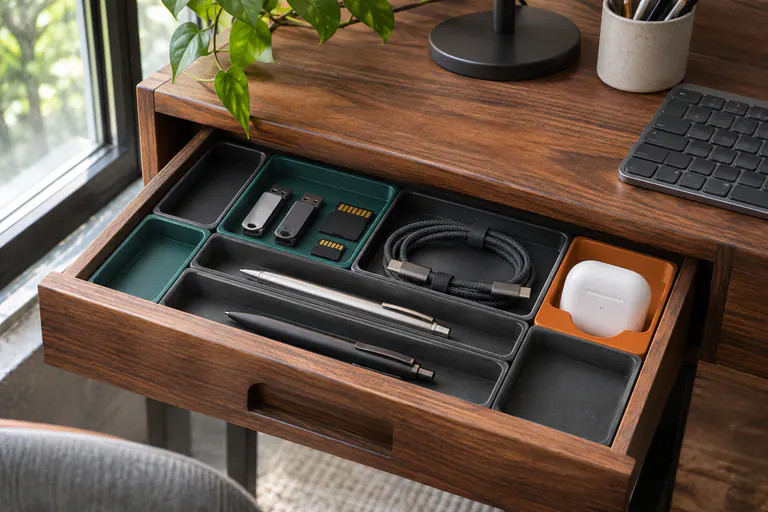
An editing drawer you can reset after a shoot
Give fresh memory cards the front-left position and used cards their own row. Add the reader beside them and leave one open pocket for the cable that changes with the camera.
Check it in the real space
Place your finger and thumb around a real card before marking the neighboring pocket. Close the drawer with the largest cable still coiled.
Start with a Media Dock if cards are the only problem. A fitted drawer can also account for the reader, adapters and your charging case.
See the Media DockWhere are you starting?
Start with this decision
Lay your earbuds, pen, charging cable and the other things you really use on a table. Pick them up as if they were still in the drawer. Leave those finger gaps on the plan and give items used together neighboring pockets.
Try the project toolWhat you can make
- An editing drawer with a card dock, a reader pocket and loose cable storage
- An AirPods charging-case pocket beside a pen channel and an open catch-all
- A long handled-tool lane with neighboring bits and fasteners
- A shared work surface with individual lift-out trays for each project
Read the studio’s approach
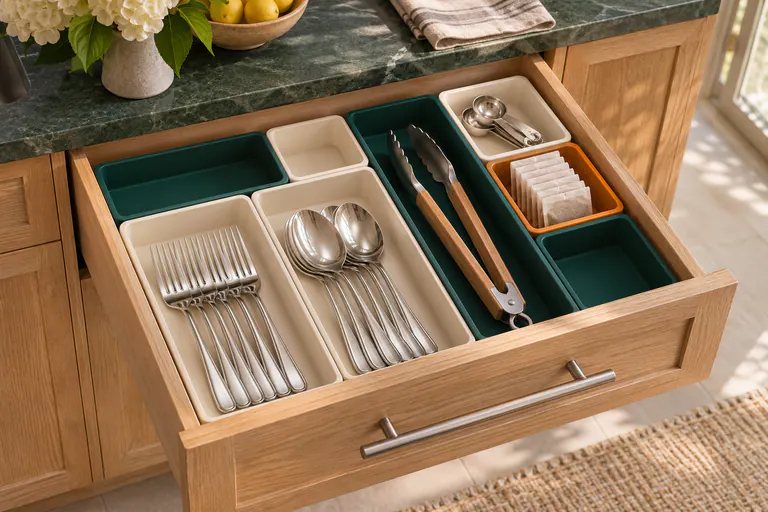
An editing desk needs a safe place to set an SD card between cameras. A kitchen drawer needs a lane that lets the serving spoon come out without lifting three other utensils. Both start with the same question. What do your hands reach for first? Map those items onto removable ForgeCells, leave space to lift them out, then ask the St. Simons Island studio to check your measurements and price the layout.
Lay out your drawer
Use the real ForgeGrid™ builder to size the base and place your cells. GridScan AR™ can help estimate the drawer floor from a reference card.
See how other spaces use the same idea.
A long spoon, a pair of calipers and a charging cable each need a different kind of compartment. Pick the nearest example and see how the layout works around the object.
How to compare ForgeGrid™ and Gridfinity for your drawer
Questions before you start
How do I measure a drawer for a custom modular organizer?
Measure the clear inside width near the front, middle and back, then the front-to-back distance on both sides. Use the smallest usable result for each axis. Also check the opening and clear height under any rail or overhang along the drawer’s travel.
What can my phone measure from a drawer photo?
A known-size card lying flat on the drawer floor gives the photo a physical scale. The guide uses the card and visible inside edges to estimate the floor’s width and depth. Check the tightest span with a tape, then measure closing height separately.
Will existing Gridfinity bins fit a ForgeGrid™ base?
Both systems use a nominal 42 mm horizontal pitch. Actual engagement also depends on the foot profile, lip, corner clearances and any magnets. Share the existing bin or its drawing and trial-fit one physical combination before mixing a whole drawer of components.
Can I change a layout after a phone scan?
Yes. Apply the measurements on the phone or bring the measurement code back to the builder. The placement controls let you move, rotate or remove cells. When a smaller measured footprint conflicts with an existing layout, review the proposed rearrangement or keep the previous drawer.
How can I tell whether a loaded module will clear the cabinet?
Measure the assembled base, the installed module and anything that projects above its lip. Compare that total with the lowest obstruction encountered as the drawer closes. Check tool handles and tall USB drives individually. A cell can fit the floor plan while its contents still project too high.
What is the difference between a universal tray and a model-specific pocket?
An open tray is a good choice for changing contents such as keys, adapters or thumb drives. Ask for a fitted pocket when an object needs to sit in one orientation. Include its exact model, the case you keep on it, how you pick it up and any connector that must remain accessible.
Can I keep a parts list while comparing two desk layouts?
Export each layout with a different name and download its itemized kit bill. Compare the plate shapes, module quantities, finish and subtotal alongside free pockets and access to your tools. The estimate excludes shipping and tax.