
Where to store a capped hot knife, hand tools and swabs on a small tabletop
Place the cooled, capped hot knife in a dedicated slot with its handle easy to reach. Give ordinary hand tools their own row, then keep swabs where you can lift one without passing over the tools. On a small tabletop, the longest capped item usually sets a more useful starting dimension than the number of accessories you own.
Configure cooled-tool storage in DabLab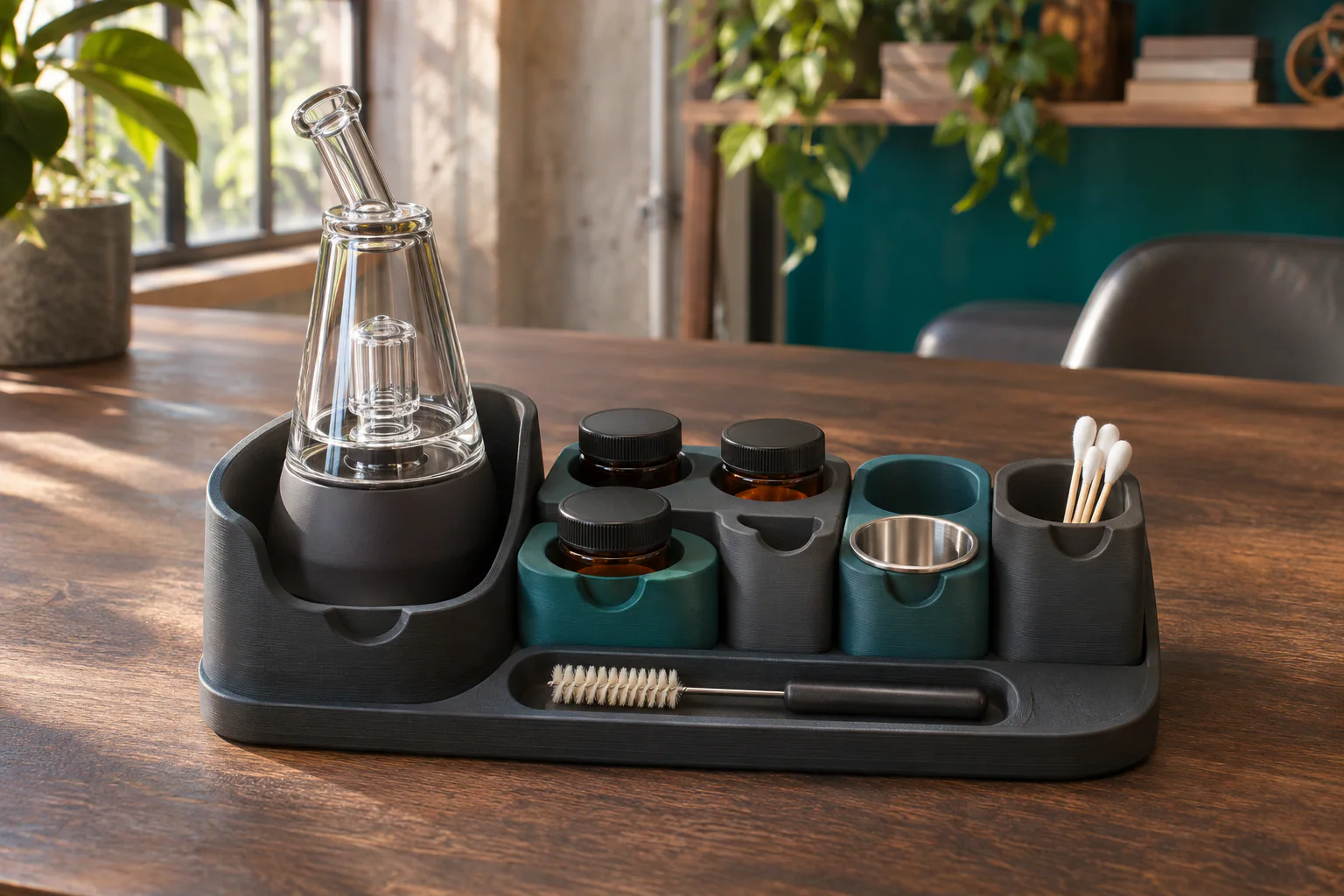
Measure the shape that actually goes into storage
Lay the capped tool beside a ruler and mark both ends. Record the widest part of the body, any raised button and any lanyard loop or attached strap. Puffco describes the cap and lanyard loop on its current Hot Knife. Older models and other brands may have a different body. Give the studio the exact tool you have, especially if a sleeve stays on it.
Run the same exercise with your hand tools. A thin shaft and a broad sculpted handle need different pickup room. Space the handles the way you would like to see them from your chair and photograph the row. This is more informative than the instruction “three tool slots” alone.
Plan the pickup, not just the storage slot
Place a pencil beside the capped tool and try lifting one without nudging the other. A full-length tight channel can bury both ends. Exposing part of the handle, or leaving room for your fingertips along one edge, can make a shallower slot easier to use. A long strap needs its own position; a dangling loop lying across the next slot cancels out much of the benefit of separate storage.
Keep this an arrangement for equipment that is switched off and cooled. Follow the device maker’s instructions for cooling and capping. A printed organizer is a storage accessory rather than a surface for resting an active heating tool.
A compact layout you can reproduce
For a scale example, enter illustrative device dimensions of 88 mm wide, 92 mm deep and 165 mm tall. Choose one cooled hot-knife slot, three hand-tool slots, both swab cups and zero jars or grid inserts. The current DabLab plan occupies 284 by 145 mm. On a 300 by 160 mm clear shelf, that leaves 16 mm across and 15 mm front to back in total. Those small differences are a reason to check your grip, not just compare two rectangles.
Spend space on the parts that stay there
If you do not keep jars on this table, start with the Tool station layout. Remove a spare tool slot if everything you want to park is already accounted for. If you do keep one jar, add it in the builder and look at the revised plan before sketching a bigger station. Save the design for a fit review with the capped tool length, device measurements and direction you normally reach from.
Questions & answers
Should the hot knife slot and the hand-tool slots be the same size?
They serve different shapes. A capped electric tool can have a wider handle, raised controls or a strap loop, while a hand tool may need support at a narrow stem. Record the widest section and the full stored length of each.
Can I rest a hot tool in the slot while it cools?
Use the slot for a cooled, switched-off tool. Follow the tool manufacturer's directions for cooling, handling and replacing the cap. A visual fit in the planner does not establish resistance to a heated tip.
What if my capped tool is longer than the slot shown?
Send the measured full length and a side photograph in your custom request. The configurable tool count gives the preliminary layout. An unusual handle or length needs studio review before the final geometry is set.
Should I include the charging lead in the tabletop layout?
If the lead normally lies alongside the stored tool, mark its route and plug head on your drawing. A separate cable pocket or nearby shelf may be enough; the storage slot alone does not add a charger.