
Center console tray or deep divider for sunglasses and a charging phone?
Choose a shallow tray when sunglasses need a protected upper shelf and you often reach into the bin below. Choose a deep divider when a tall phone, its cable, or a bulky glasses case needs a full-height lane. Compare the two layouts with the vehicle parked, using the phone in its usual cover and the sunglasses in their usual case.
Compare layouts in the console planner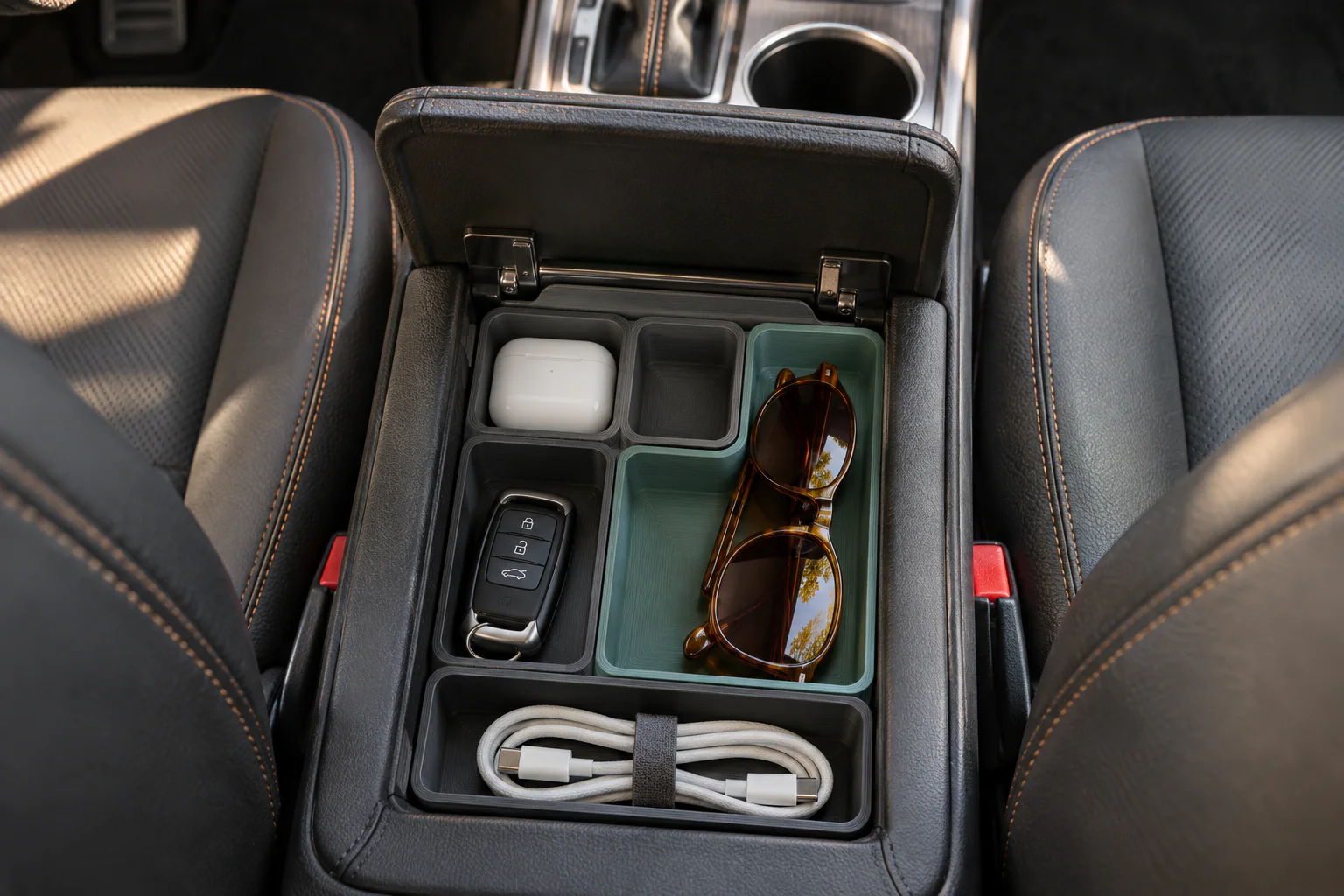
A top tray puts the glasses where you can see them
Place the closed glasses case on a strip of card spanning the factory ledge. Check whether you can reach the case without first removing the phone. Hard-shell glasses cases often swell in the middle; measure that fattest point and the hinge end. If you prefer loose glasses, account for the folded temples and use an appropriate protective resting surface for the lenses.
The tradeoff appears when you need what is underneath. A fixed, full-width tray makes the lower bin harder to reach. A removable half-width tray might preserve a clear hand path while keeping the glasses at the top. Draw the outline of your hand beside the tray when you make that comparison.
A divider preserves vertical room and cable access
Set the phone and cable into the empty console as one assembly. Locate the port and record which way the connector exits and where the cable naturally turns. A divider can keep a hard glasses case from knocking against the phone and leave a lane down to the port. Avoid a tight gap that pinches the cable between the phone and a wall.
Choose the orientation that allows removal by the phone body while parked. Pulling up on the cable puts the load at the plug. If the phone has a thick grip or wallet cover, measure that highest point as well as the rectangular outline. A longer, wider section that is open at one end can serve several phones over time.
Compare two paper layouts in the same console
Suppose the clearance above a support ledge is 53 mm. A mock tray with a 4 mm floor and a glasses case 47 mm high uses 51 mm. Just 2 mm remains in that example before accounting for a curved lid or raised pad. If the paper stack catches, move the case lower or choose the divider. The same arithmetic applies to your measured dimensions.
Run through three ordinary motions: lift the glasses while leaving the phone in place, unplug the cable without disturbing the case, and retrieve something from beneath the organizer. Check full lid closure after each setup. The version that passes all three in your parked vehicle is the better fit for the way you use it.
Configure the winning arrangement
Open the ForgeGrid center-console planner and enter the space at the level the chosen organizer will occupy. Note the phone with its case, the plug direction, the glasses case size and whether the lower bin must remain accessible. If neither full-width approach works, sketch a short upper shelf beside a deep open lane and ask the studio to review that arrangement.
Questions & answers
Is a shallow organizer better for expensive sunglasses?
The protective case and the way it rests matter most. A tray can keep that case visible, provided the loaded tray clears the lid and the glasses remain protected from keys and other objects.
Will a universal phone pocket fit a case with a grip?
Only if the pocket clears the complete assembly. Measure across the grip, confirm the cable can leave at a comfortable angle and check you can lift the phone without pulling on the cable.
How do I keep access to the lower console bin?
Try a shorter tray, a half-width shelf or removable modules. Mock up the amount of space your hand and the largest item from the lower bin need to pass.
Can I use the same layout for two drivers?
Measure the larger phone and case as stored and try both drivers’ cables. Give the glasses their own bay and keep an open phone side if the devices differ substantially.