
A Christmas gift for a guitarist with picks in every pocket
Buy a spot to put the pick down between songs. That sounds less glamorous than guessing which boutique picks a guitarist might like, but it solves a very specific problem. The thick triangle they use for bass, the worn teardrop they like for acoustic rhythm and the stiff little point for lead already exist. A ForgeGrid gift can put those favorites within reach without asking them to change what they play.
Design their guitar pick organizer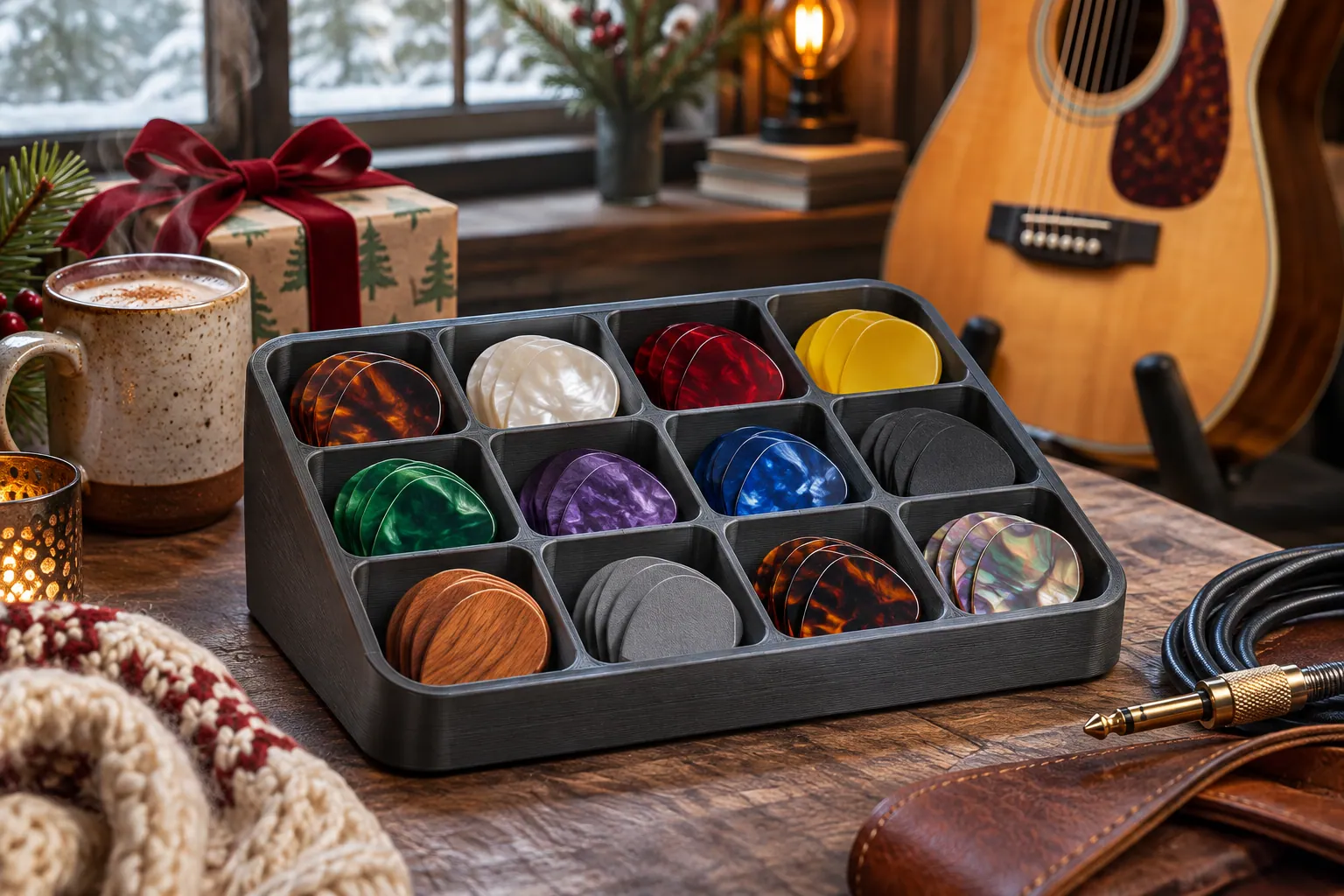
Follow the pick after the last chord
Where does your guitarist set a pick when someone calls them to dinner? The shelf beside the practice amp, the table next to a music stand and the drawer under a recording desk suggest three different gifts. The shelf calls for a small return pocket. The recording drawer can hold a few categories. A gig bag calls for a closed travel case, which serves a different job from an open tabletop tray.
If you are keeping the present a surprise, borrow a pick with permission or ask for a photo next to a ruler. Find out whether the odd-looking piece is a favorite before treating it as a spare. A thumbpick needs room for its curved band. A flat triangle scarcely needs any height, but it does need space to tip or slide out.
Give the player one decision between songs
Try dividing ten sample picks into three piles on a sheet of paper. Make one pile for tonight’s picks, one for alternatives and one for worn picks the owner still likes. If a player wants to compare shapes by touch, place the active pocket nearest their picking hand. The rest can sit farther away. For someone who uses the same pick all evening, one generous pocket beats a miniature filing cabinet.
Drop a thin card into your paper outline and pretend to take it out with finger and thumb. A narrow compartment that fits the shape exactly can make the smallest item remarkably hard to grab. Make room for the hand as well as the collection.
Size the tray to the practice spot
Measure the clear width, depth and height of the chosen drawer, including the point where the top edge passes under the desk. In ForgeGrid, start with a small-parts sorter or open storage cell. Print the planner’s full-size paper template and place it beside the amp or inside the drawer. With a shelf layout, leave the amplifier’s controls and ventilation clear.
Use the configured layout to request a studio build. If you want a contour specific to a thumbpick, put that requirement and the real dimensions in the project notes so the studio can review it.
Wrap it with a reason to use it tonight
Write the name of the first song you would like to hear together on a card. Place a paper pick outline beside it if you are presenting a design you will finish together. Let the guitarist put the real favorites away after opening. That preserves the surprise and avoids borrowing a stage pick right before a performance.
Questions & answers
What is a good Christmas gift for a guitarist if I don’t know their pick gauge?
An adjustable storage layout lets them keep using the picks they prefer. Ask where they practice and how many styles they rotate. Those two answers tell you more about the organizer than the printed gauge on any single pick.
Will a guitar pick tray also hold fingerpicks?
Only if the compartment accommodates their full curved shape and height. Stand one the way the player normally stores it, measure its widest points, and leave a way to lift it without bending the band.
Can I add small guitar accessories to the layout?
A spare tuner battery in its original packaging or a capo can have a separate compartment if its dimensions work. Keep heavier metal items away from the pick pocket so the player can sweep out a pick easily.
Is this a pick case for carrying to gigs?
The planned gift is an open organizer for a stationary space. For loose transport use the guitarist’s closing case. A useful pairing is a drawer pocket sized for that closed case when they get home.
How do I check the organizer before ordering for someone else?
Take the actual measurements or let the recipient complete that step after Christmas. Use the printable footprint to check obstructions, then describe any special contours when requesting the studio review.