
Before ordering 40 custom table-number holders, try one during a real service
Choose the table-number holder your team can find, read and reset during a busy service. A number that looks elegant in a straight-on rendering may disappear behind a water carafe. Before ordering forty, put one physical proof on the smallest table you plan to use and give the person delivering food a chance to try it.
Quote one table-number proof and my batch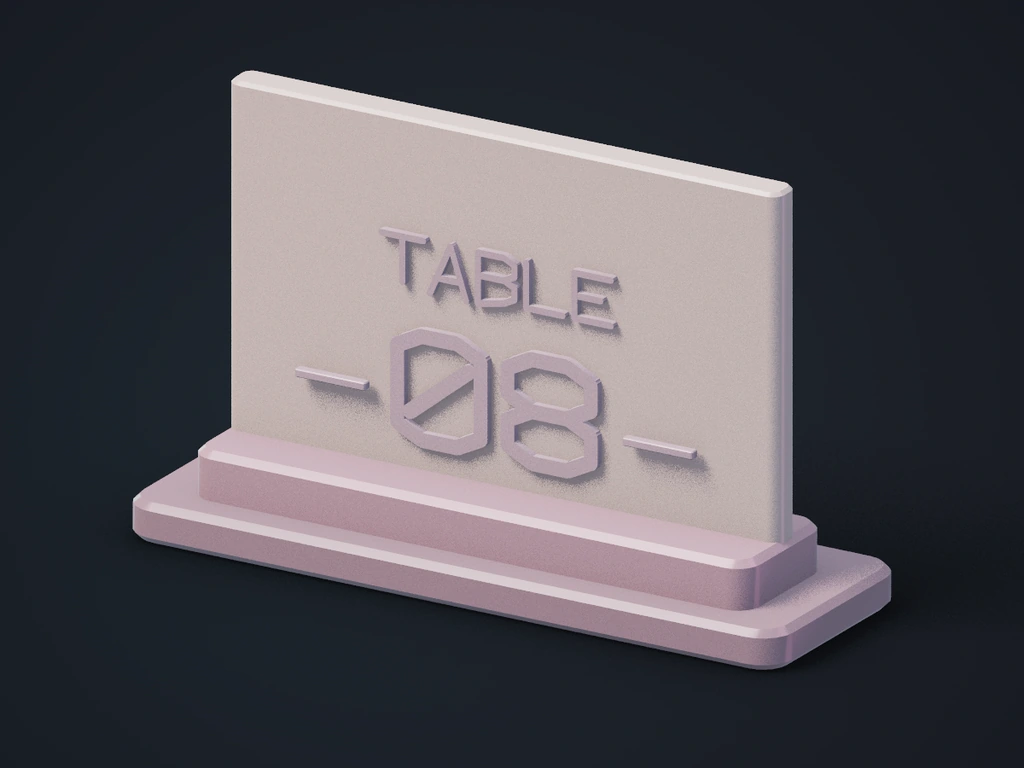
Trace the route the number has to work from
A Golden Isles dining room might seat guests indoors, on a patio or under a covered porch. Start by walking the food runner’s path. Mark the first place they must choose between two rows of tables. From there, look past seated guests, menus, glasses and centerpieces. That is your first viewing position for the number.
Test a two-digit number in the proposed typeface. A large numeral 1 leaves open space that can make the proof look much more readable than a real table 38. Check front and back if servers approach from both sides. If staff use the card to identify a party and guests use a QR menu separately, give each object its own clear job.
Size the base around the setting
Tape the proposed footprint onto a small two-top, then set the table for two actual meals. Add water, utensils, a shared dish and the condiment container. Watch whether the base has to move before a plate can land. A broad, low base and a taller narrow base take up space in different ways; a paper rectangle only answers the footprint question.
Decide whether the number is permanent, printed on a replaceable card or inserted in a separate face. Measure the thickest card after lamination. Mark the desired slot width for studio review and check the real card in the first proof. A table marker is much easier to reset when staff can straighten or replace the card without tools.
Give a proof one shift’s worth of questions
Try the sample at the host station, on a set table and in the storage bin. Record which numbers become difficult to recognize, whether the piece tips during normal table clearing, where glare obscures it and how servers carry several at once. For an outdoor use case, check the venue’s actual conditions and handling procedure separately.
Ask staff about wiping and storage. Share the cleaner name and expected routine with the studio, then confirm material suitability before ordering. Keep a labeled photograph of the approved base and card together. That record matters if someone requests replacements after the original designer has moved on.
Separate pilot pricing from the forty-piece order
ForgeCloud lets you submit the concept or estimate an existing model. Request one proof, the full numbering sequence and the expected number of spares as separate quantities. State whether the forty pieces share the same base and change only by insert. Ask for confirmed production timing and complete pricing once the proof is approved.
Questions & answers
Should table numbers be visible from both sides?
Use two-sided numbers if servers approach from different directions. Walk the actual routes with the proof and ask staff where a one-sided card disappears from view.
What number should I use on the first proof?
Choose a two-digit number with shapes that can be confused at a distance. Also check a sample of the longest text if you use table names for private events.
Is one proof enough for indoor and patio tables?
It can be a starting point, but the tests differ. Try the physical sample in both environments, including the patio furniture, lighting and the restaurant’s normal setup and clearing routine.
Can I reorder just a missing number later?
Ask how the design and numbering are retained and how small future quantities are priced. A reusable base with swappable cards can also make it practical to replace an insert separately.