
A renter's kitchen drawer makeover you can lift out on moving day
The part worth taking to your next kitchen is the kit you reach for: flatware sorted the way you like it, measuring spoons in their own cup and the small tools you use every morning. The drawer itself will probably change. Design removable groups first and fit the base around the current drawer second. On moving day you can carry those groups intact instead of starting with another box of loose utensils.
Build my removable kitchen drawer layout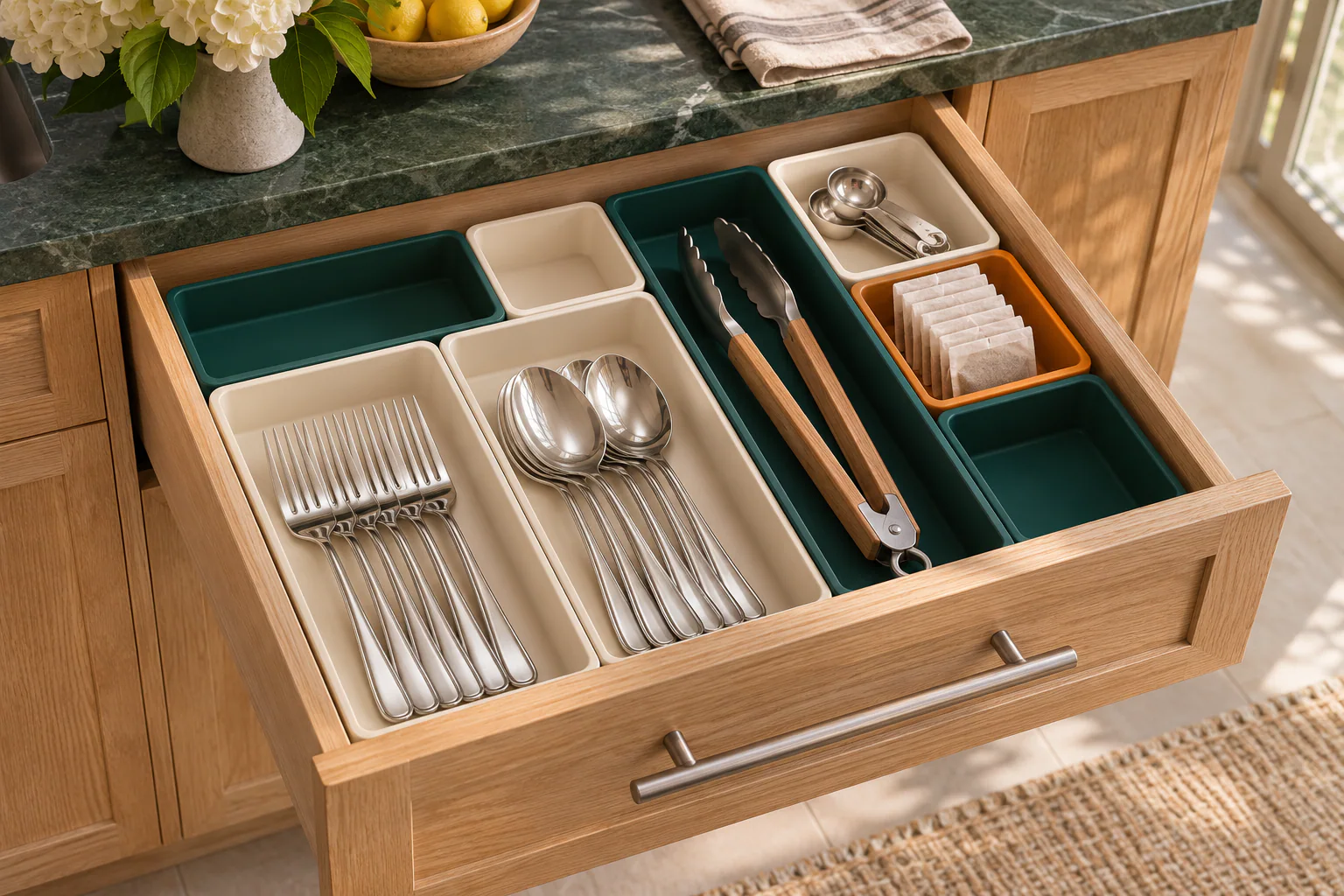
Measure what you have permission to leave alone
Take out loose liners and wipe out the drawer. Keep integral hardware, stops and fixed dividers in place. Measure clear width near the front and back, depth to the first obstruction and the height available under the cabinet opening. Note a protruding fastener or rounded corner on a sketch. If you keep a removable liner, measure with it installed and check whether its texture makes an empty tray sit unevenly.
A rental drawer may open only partway. Pull it to its ordinary stop, then try lifting out a cardboard rectangle the size of the planned base. If the rear stays under the counter, a pair of small bases or a shorter removable section may be easier to lift.
Give the movable pieces real jobs
Build one long group for the flatware you use at every meal. Make a second group for items you take to the stove, such as a peeler, measuring spoons and bag clips. Give unrelated tools an open bin while you learn how you use the kitchen. A removable module earns its keep when it can travel as a unit from drawer to counter or from one drawer to another.
Choose a fitted base for the present drawer only after those groups make sense. A made-to-measure outside frame can use awkward space well, but a different drawer may need a different frame. Ask which individual bins and grid pieces can be rearranged independently if reusing them later matters.
Imagine the next drawer is narrower
Suppose your current drawer has a clear base 400 mm wide and the next kitchen gives you 325 mm. A rigid 390 mm tray cannot move over in one piece. Two independent 150 mm groups may still work side by side if their outside dimensions and clearances fit. Even if the new drawer is shallower, one could move to a second drawer. This is a planning example, not a promise that bases from different systems interlock.
Place the paper outlines separately in a second location in your current kitchen. Could the daily kit work beside the stove? Would the baking kit make sense in a cabinet? If the groups are useful without the present shell, they are worth building around.
Order the pieces that make this rental easier today
Start with the ForgeGrid kitchen plan, mark the drawer's fixed features and select the bins you want to lift out. Tell the studio that a removable setup is a priority and ask for a fit that can be retrieved without drilling or fastening into the cabinetry. Save the final dimensions with your moving notes. At the next address, you can measure the new drawer and review which pieces deserve a second home.
Questions & answers
Do I have to attach a drawer organizer with adhesive?
A removable base can be designed to sit inside the drawer. Describe the drawer surface and likely movement when requesting the fit. If adhesive-free removal is a priority, include that explicitly in the brief.
Will everything fit my next rental?
The new drawer's usable opening, floor and height decide that. Smaller independent bins give you more possibilities. A single base cut to the first drawer's full footprint is the component least likely to transfer unchanged.
How can I stop small items getting buried behind the tray?
Measure the depth the drawer actually exposes when open. Place daily items within that reach, then use a small lift-out cup for the occasional accessories you would otherwise have to hunt at the back.
What measurements should I keep after moving?
Save the outside dimensions of the base and each removable kit, plus a picture showing how they sit together. Compare those numbers with the new drawer before requesting a replacement base or extra cells.