
How to organize tea bags and loose-leaf tins in one shallow drawer
Give each tin a footprint based on its lid and each sachet a lane based on its wrapper. The trick in a shallow tea drawer is to let some items lie down. A row of packets you can read and a tin you can lift are worth more than an impressive count of compartments.
Design my kitchen tea drawer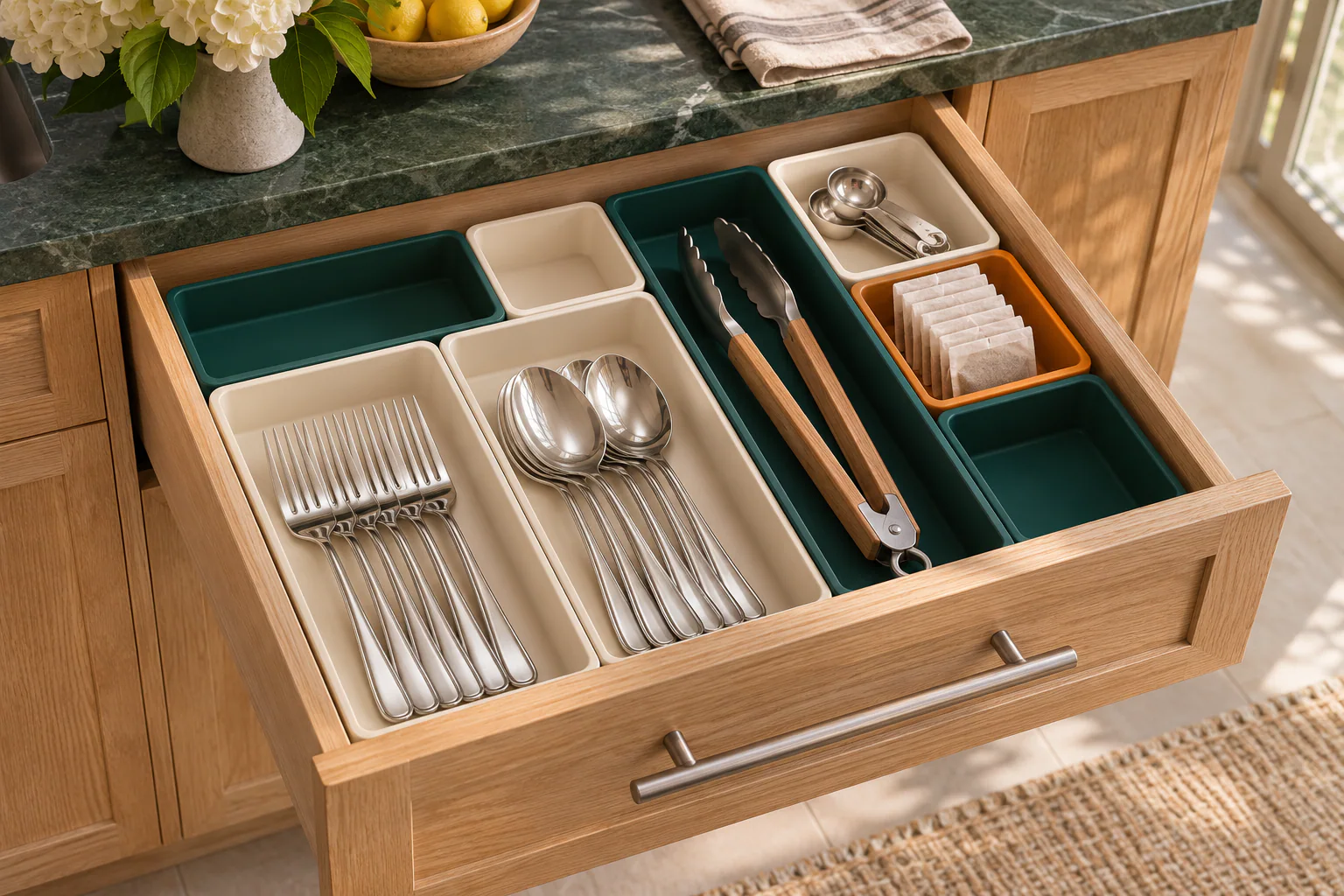
Take inventory with the lids on
Set out what you actually drink in a typical week. Put your morning tea, evening tea and anything you offer guests in separate groups. Keep refill cartons and seasonal blends off the table for now. A family box of fifty bags has a different job from the six or eight packets you want to reach before breakfast.
Measure the tallest closed tin, the widest lid, and the broadest wrapped bag. A square tin needs both side measurements. A round lid that projects beyond the body dictates how close the next tin can sit. Include space to curl your fingertips around the one you reach for, then check whether you can remove it while its neighbors stay in place.
Decide which bags can stand on edge
A wrapper that is 68 mm tall cannot stand upright in a drawer with 60 mm of clear height. Turning it ninety degrees may help if its other edge is shorter. Otherwise, use a shallow row of overlapping packets with the variety printed toward the front. Slip in a plain paper divider marked “decaf” if the manufacturer uses similar colors across blends.
To test capacity, make a stack from actual sealed packets. Ten thin envelopes and ten pillow-shaped sachets can occupy very different lengths. Check whether your fingers can separate two neighboring bags when the row is freshly refilled. Leaving the last packet in place while refilling helps you read the group at a glance.
Make the tin lane removable
Try a cardboard strip the width of the largest lid. Lay it down the side nearest your kettle and place the tins on it as a group. Put the one with the loosest lid toward the front where you can lift from the body. If a tall tin only fits on its side, check its closure and choose another location if the lid slides free.
Keep loose leaves in their own closed food-storage container. Give a clean, dry scoop its own short lane, with the handle pointing toward your working hand. That avoids having to pick the scoop out from under a ring of tins whenever you change blends.
Turn the successful arrangement into a ForgeGrid layout
Measure the inside floor and the lowest point under the drawer opening. Use the smaller usable dimensions when the sides taper. Photograph the arrangement from above with your widest lid in place. Open the ForgeGrid kitchen planner and choose removable trays for packets and tins; request a custom pocket if a particular tin needs to sit in one orientation. Tell the studio which bin should come all the way out for refills.
Questions & answers
How tall should a tea bag drawer divider be?
Choose a divider low enough to reveal the flavor label but tall enough to keep the packets separated. Stand the actual packets behind folded card at two heights and check which one lets you pick out a single bag.
Can I mix individually wrapped tea and loose-leaf tea in one drawer?
Yes. Leave the loose leaf in its closed tin and group the wrapped bags beside it. Size the organizer around those containers so the printed tray serves as external storage.
How do I organize round and square tea tins together?
Put the square tins edge to edge as a block. Test the round lids in a separate lane. Small gaps between round corners make useful grip space, but avoid counting those gaps as room for another whole tin.
What if the drawer only opens halfway?
Place daily blends in the visible front area and put refills in a tray that pulls forward or lifts out. Test removal while the drawer is at its normal stop, including the height needed to tilt the tray.