
How to organize leaders and line spools in a shallow boat drawer
Keep full leader spools face-up in a shallow drawer, and give loose coils their own removable compartment. You should be able to read the line rating and lift a single spool without unwinding the one beside it. Start with the largest spool you actually carry. A drawer fitted to the emptiest spool in the boat will disappoint you after the next tackle-shop visit.
Plan my boat drawer around my spools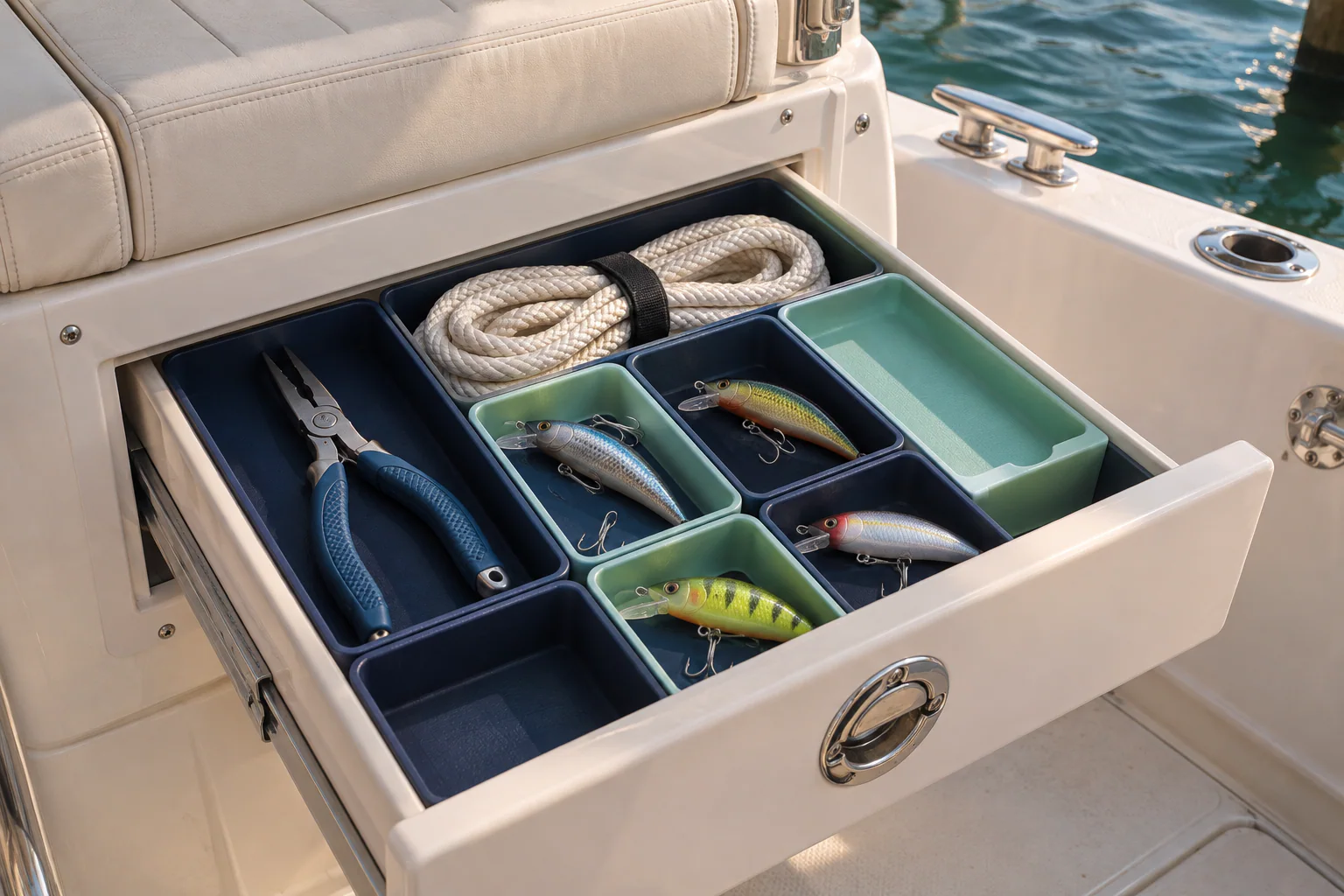
Sort for the moment you need another leader
Lay the spools out with their labels up. Make two piles: the handful you reach for on a normal trip and the backups that only come out when something runs out. Give the everyday sizes the row closest to your opening. If two spools look alike, put the line rating or diameter on the visible face of the compartment. That label is useful after you lift out a spool as well as before.
Keep loose pre-cut leaders in their own labeled sleeves. Dropping loose coils between spools makes every retrieval a little harder. A pocket sized around the widest loaded sleeve is easier to live with than a collection of bare coils in a deep bin.
Compare two orientations on paper
Suppose a full spool is 80 mm across and 24 mm thick and your drawer has 55 mm of clear height. Standing that spool upright would need at least 80 mm before any support goes underneath. Face-up, it starts at 24 mm. Stacking two brings the spools alone to 48 mm, leaving only 7 mm for the tray floor, anything protruding, and clearance. That calculation explains why a single readable layer can be preferable even when a stack seems possible.
Trace the outer flanges on paper. Leave a gap on one side of each circle, then physically pinch the rim with the hand you use aboard. Add that space before counting how many circles the drawer takes.
Let the opening determine tray size
Measure the narrowest point past the hatch lip as well as the interior. Tape your outline to cardboard and pull it through the opening with the drawer extended as far as it normally goes. If the rear corners catch, split the layout into an everyday tray and a refill tray. A smaller loaded tray can be easier to carry to the dock than a full-width panel.
Build a boat layout around your own gear
Open the ForgeGrid boat planner with the drawer measurements, largest spool diameter and thickest loaded sleeve at hand. Lay out the removable sections first. Tell the studio if gear must stay captured underway or if the existing locker has a drain or latch that must remain clear. The open layout is for organization at rest; the retention needed on your boat is a separate design question.
Questions & answers
How do I measure a spool for a boat drawer organizer?
Measure across the widest part of both flanges and record the thickness with any keeper band attached. Take a second measurement from the next-largest brand you carry. A well that fits both is more useful than a close fit around only the thin spool.
Can I put multiple line strengths in one bin?
Yes, if you can see the labels and remove one spool at a time. Group the strengths you regularly compare side by side. Put duplicate refill spools in a different location so they do not bury the working set.
How should I store wet pliers beside leader spools?
Give the pliers a separate removable section and leave the original drainage path accessible. Choose a place where you can lift the tray to clean and dry the compartment. Include the tool's actual handle width in the layout.
What if the boat drawer does not come all the way out?
Measure and mark the exposed depth with the drawer at its natural stop. Place infrequently used sleeves in the hidden portion. Use a cardboard mock-up to confirm that the everyday spool tray can come out with the drawer still mounted.