
Toolbox foam or 3D-printed inserts? Compare them in the same socket drawer
Choose cut foam for a settled collection of oddly shaped tools that each need a recognizable home. Choose modular printed inserts if your socket sets change, you want rows you can move, or one part of the drawer goes to the bench with you. A mixed drawer can work especially well: leave the ratchet in a shaped recess and put the regularly changing sockets on a removable rail.
Compare socket rails in my ForgeGrid toolbox layout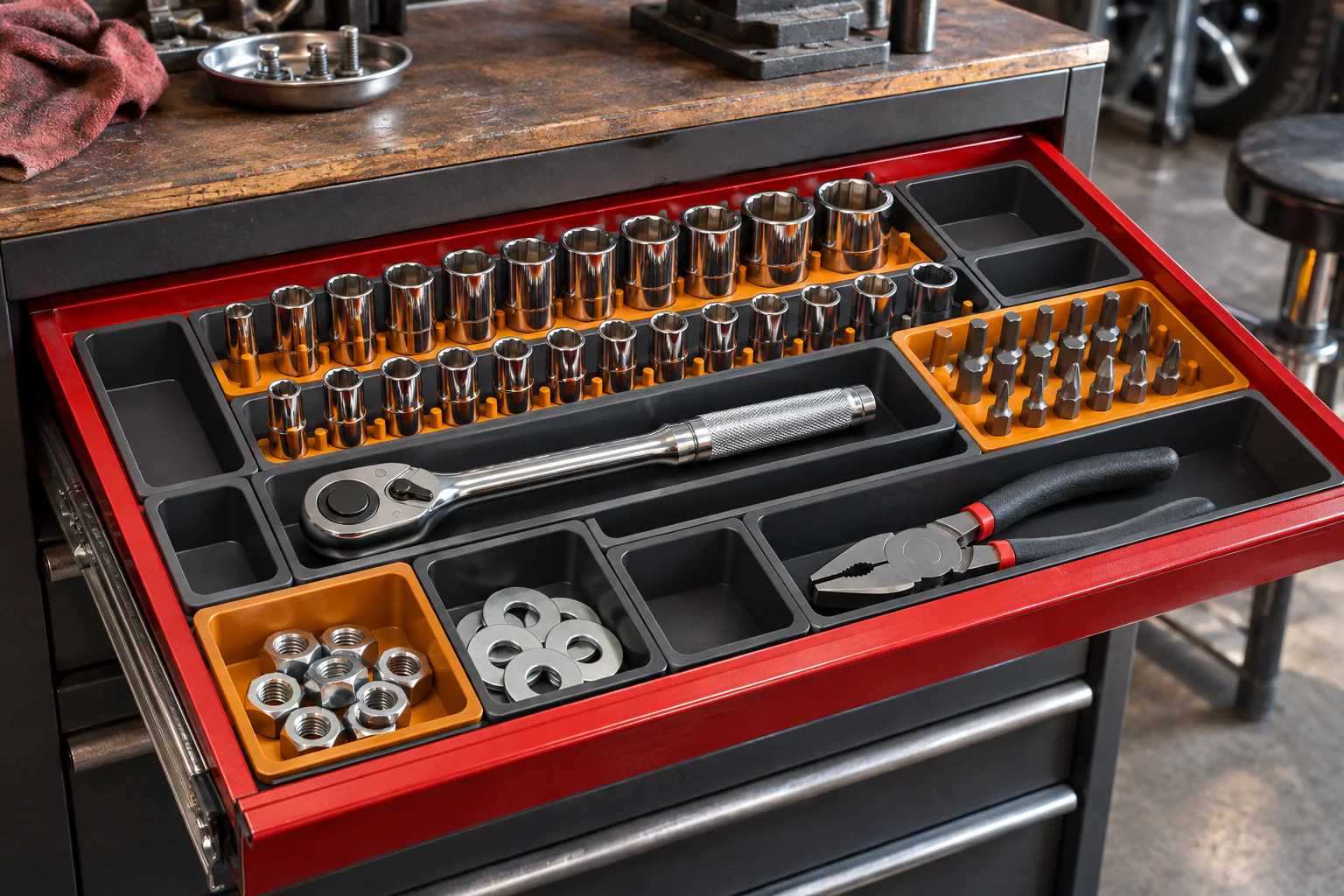
Draw the same drawer twice
Trace the usable drawer floor, including any liner you intend to keep. Make a second copy. On both, mark the handle you pick up most and the socket that goes missing most often. Give them the same positions on each sheet. This keeps the comparison honest: the relevant question is how each material serves your tools in your drawer.
In the foam version, trace the outside of each piece and add a scoop where fingers can reach under it. In the printed version, draw a rectangle for each rail or bin and mark the visible label edge. Try picking a middle socket while the neighbors stay in place. A dozen outlines touching on paper make a poor layout if the only socket you can grasp is the one at the end.
Compare height with a loaded socket
Read the height at the tightest point under the drawer above. In a hypothetical drawer with 58 mm of clearance, a 52 mm socket raised 8 mm by a support reaches 60 mm. It cannot stand there. If a different design recesses the same socket, measure the actual loaded height. Adding the full insert thickness to the full socket length can overstate the height when the socket sits down inside it.
Decide what happens when the set changes
Picture adding a wide impact socket next month. A shaped foam pocket for a slim chrome socket may need recutting. A modular rail can be replaced or moved, but only if its spacing works for the larger body. Ask for the widest outside diameter as well as the square drive size. Keep one short stretch open for specialty pieces instead of filling the last square on the drawing.
Choose the mix you'd use on a Tuesday
If you carry the whole set across the shop, plan a removable socket section you can lift with both ends accessible. If the tools remain at a dedicated workstation, close-fitting outlines make a missing item particularly visible. ForgeGrid's toolbox layout gives you a graduated socket rail, longer tool storage and small-part options. Start with the section causing trouble today and build the rest around it.
Questions & answers
Which insert makes missing sockets easiest to spot?
An outlined foam pocket gives a missing tool a silhouette. A printed rail gives each socket a repeatable position. In either layout, a size marked on the insert remains visible when the tool leaves. Use that lasting label on sockets that people borrow.
Can I use a printed rail alongside foam I already own?
Yes, if the rail fits the unused rectangle and both sections stay level on the existing liner. Cut a paper outline of the planned rail first. Check that it lifts out without catching the edge of your existing foam.
Which works better for deep sockets in a shallow drawer?
Try a sideways row before changing materials. Lay one deep socket flat, include a finger scoop or exposed end and measure the row length. Several sockets lying flat can fit under a low rail where none can stand.
Will either option keep tools secure while a toolbox travels?
Open wells and rails organize tools at rest. For a mobile box, describe the travel orientation, lid or drawer closure and retaining system when requesting a design. Drawer organization alone does not establish transport retention.